

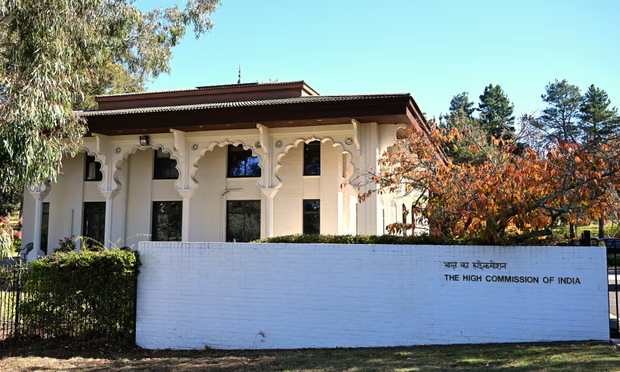
Source: The Guardian
SDT News: The Australian government has reaffirmed its commitment to protecting the country from foreign interference following media claims that two officers from India’s Research and Analysis Wing (RAW) were compelled to leave Australia five years ago.
Australia’s domestic intelligence agency, ASIO, had earlier revealed the discovery of a “nest of spies” from an unspecified foreign power that attempted to influence politicians, keep tabs on diaspora communities, and access confidential trade data.
According to The Washington Post, the two RAW officers were expelled in 2020. The Australian Broadcasting Corporation (ABC) later suggested that “a number” of Indian officials had been removed from Australia by the then Morrison government, though Guardian Australia has not independently confirmed these accounts.
Foreign Minister Penny Wong, while refusing to confirm details of the 2020 incident—which occurred before the Albanese government took office—stressed Canberra’s determination to combat espionage and foreign interference. She underscored that ministers have consistently emphasized the need to safeguard Australia’s democracy from external influence.
“We have legislation to address such threats,” Wong stated during a press conference in Melbourne. When asked about possible concerns within the Indian diaspora, she reiterated the government’s appreciation for Australia’s multicultural character, calling it “a strength” and encouraging continued civic participation.
The Washington Post also linked the 2020 case to other clashes between RAW and Western security agencies. The paper noted that German police had arrested suspects accused of spying on Sikh communities for RAW, while the UK’s MI5 had warned India over similar surveillance activities in Britain.
The alleged expulsions were also referenced indirectly by ASIO Director-General Mike Burgess in a 2021 address, in which he discussed uncovering a “nest of spies” from an unnamed nation. Burgess said Australia faced espionage operations from “multiple countries” targeting sensitive national information.
The revelations come at a delicate diplomatic moment. Just two weeks earlier, the Albanese government’s National Defence Strategy had lauded India as “a top-tier security partner” and called for enhanced cooperation and information sharing within the Quad alliance alongside the US and Japan.
Prime Minister Anthony Albanese declined to comment on intelligence matters when asked in Sydney. ASIO and the Department of Home Affairs also withheld comment.
The Indian High Commission in Canberra did not directly address the espionage allegations but circulated a general statement from India’s Ministry of External Affairs rejecting The Washington Post’s report as containing “unwarranted and unsubstantiated imputations.”
The Ministry’s spokesperson, Randhir Jaiswal, criticized the publication’s coverage of multiple alleged incidents involving India, describing it as speculative and irresponsible.
Despite these tensions, ties between the two nations remain close. During recent visits, Albanese shared a warm rapport with Indian Prime Minister Narendra Modi—famously calling him “the boss” and comparing him to Bruce Springsteen at a public event in Sydney.
Treasurer Jim Chalmers, when asked about the controversy, refrained from confirming the report’s details but emphasized that Australia’s “important economic relationship” with India had strengthened through mutual efforts in recent years.
In his 2021 briefing, Burgess revealed that ASIO had identified a network of foreign agents who built connections with politicians, foreign embassies, and even a state police force. The operatives had tried to acquire classified trade data and sensitive security details from government employees, one of whom held a defense-related clearance.
ASIO subsequently revoked that clearance, confronted the spies, and arranged for their quiet removal. Burgess later explained in an interview that Australian authorities had privately told the foreign intelligence service involved that it would be “wise” for its undeclared officers to leave by a certain date—an instruction the individuals followed “freely and quickly.”
While some national security experts have questioned whether the officials’ exit constituted a formal expulsion, the effect was essentially the same: the operatives left Australia under ASIO’s direct pressure.


