

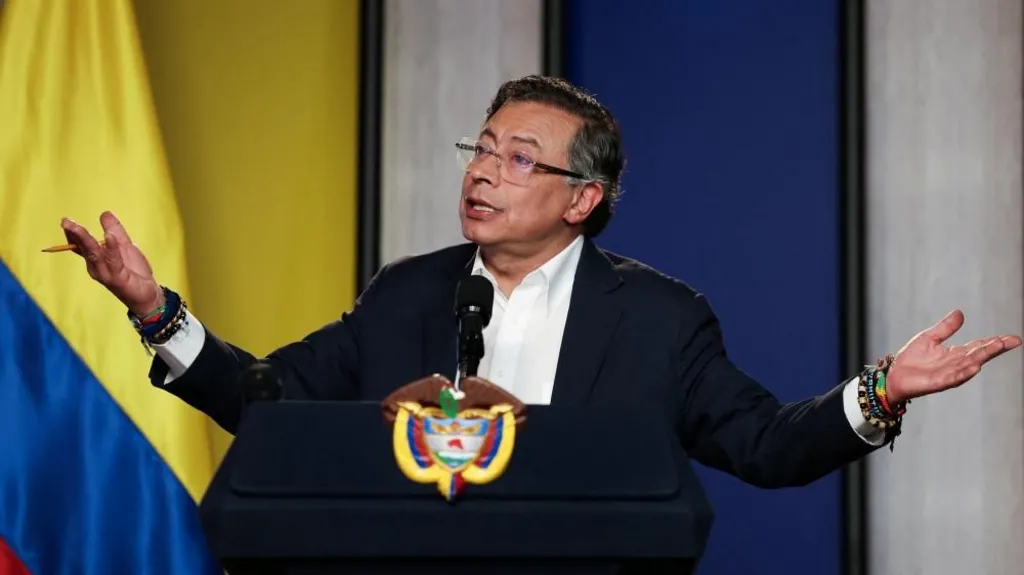
BBC Photo (File): Colombian President Gustavo Petro
Source: BBC (https://www.bbc.com/news/articles/crkl2dm2glxo)
DST News: The United States has imposed sanctions on Colombian President Gustavo Petro, accusing him of failing to curb rampant drug trafficking and allowing cartels to expand under his leadership.
The move marks a sharp escalation in tensions between the US and Colombia’s first left-wing president, deepening an already strained relationship with US President Donald Trump.
Washington cited what it called Petro’s “disastrous and ineffective” anti-drug policies, blaming them for a surge in cocaine production — now at its highest level in decades.
“Since President Petro took office, cocaine output has exploded, flooding the United States and poisoning Americans,” said US Treasury Secretary Scott Bessent in a statement announcing the sanctions.
A deepening diplomatic rift
The sanctions follow weeks of growing friction between the two leaders, fueled by US air and naval strikes on vessels allegedly used for drug smuggling in the Caribbean. The attacks killed dozens of people, including Colombian nationals — prompting Petro to accuse Washington of “murder.”
Trump defended the operations, saying countries like Colombia had “failed to stop” drug shipments bound for the US.
Under the new measures, Petro, his wife, and his son — along with Interior Minister Armando Benedetti — are barred from accessing assets or property in the United States.
The Biden administration also announced that Colombia would lose its certification as a key US ally in the war on drugs, cutting off access to certain financial and military assistance. In retaliation, Bogotá said it would halt purchases of US-made weapons.
Petro hits back
President Petro condemned the sanctions, calling them “an act of arbitrariness typical of an oppressive regime.” He insisted his government had made progress in reducing coca cultivation and blamed his predecessor Iván Duque for the earlier rise in production.
“I have fought drug trafficking for decades,” Petro said. “But the real solution lies not in bombing boats or punishing farmers — it lies in reducing cocaine demand in the United States and Europe.”
Record cocaine levels and failed peace efforts
Independent researchers in Colombia confirm that cocaine output remains at record highs. Héctor Galeano of the Institute of Advanced Social and Cultural Studies said production had reached “the largest scale in modern history.”
Petro’s policy of negotiating with armed groups — part of his promise to bring “total peace” to Colombia — has stalled amid renewed violence and breakdowns in dialogue with major cartels.
In a September interview with the BBC, Petro described recent US airstrikes on suspected drug vessels as “acts of tyranny.” Addressing the UN General Assembly shortly afterward, he accused Washington of using “violence to dominate Colombia and Latin America.”
While sanctions against sitting heads of state are rare, they are not unprecedented — similar measures have been taken against leaders of Russia, North Korea, and Venezuela.
Analysts warn the move could push Colombia further from Washington’s orbit, undermining decades of cooperation in the US-led war on drugs.


