

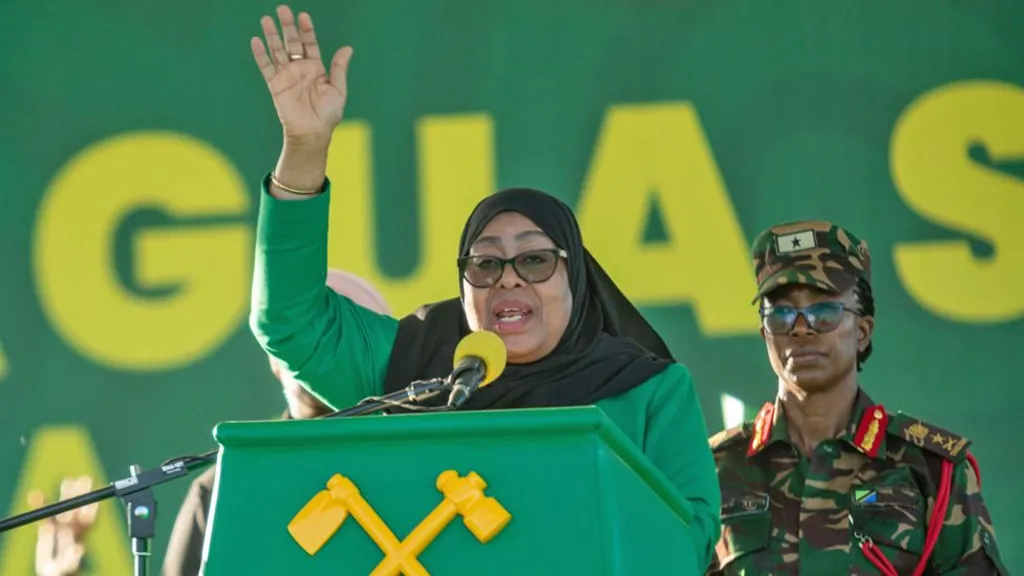
BBC Photo: Tanzania’s first female president, Samia Suluhu Hassan
Source: BBC
DST News: With the main opposition sidelined and no heavyweight challengers cleared to run, many Tanzanians say Wednesday’s presidential vote feels more like a coronation than a contest for President Samia Suluhu Hassan, who seeks her first full term in office.
The 65-year-old leader, who made history in 2021 as Tanzania’s first female president following the death of John Magufuli, initially earned praise for her softer, reform-oriented approach. Her “four Rs” agenda — reconciliation, resilience, reform, and rebuilding — reopened Tanzania to investors, revived relations with donors, and restored confidence from institutions like the IMF and World Bank.
“She made a real difference by rebuilding ties with international organizations that had distanced themselves from Tanzania,” political analyst Mohammed Issa told the BBC.
But critics now accuse her of steering the country toward authoritarianism, with reports of abductions, extrajudicial killings, and a renewed clampdown on dissent. Observers say political freedoms have narrowed even more than under Magufuli’s rule.
“Samia started with a reconciliatory tone, but now she has become tough and bold — even feared,” said Issa. “She is now being blamed for abductions, killings, and repression.”
According to Freedom House, Tanzania’s status has deteriorated from “partly free” in 2020 to “not free” last year. The government has yet to respond to the allegations.
Opposition Silenced, Voters Disillusioned
Although 17 candidates have been approved to contest the election, none represent the country’s strongest opposition forces. The main opposition party, Chadema, and its leader Tundu Lissu have been barred from participating. Lissu remains on trial for treason after demanding electoral reforms, and Chadema has called for a boycott.
His deputy, John Heche, was also arrested last week, accusing the government of “fake reforms” before his detention. “Rallies were allowed again, but Chadema still cannot operate freely,” he said.
Meanwhile, Luhana Mpina, the candidate from ACT Wazalendo, Tanzania’s second-largest opposition party, has been disqualified twice. His appeal to the High Court briefly restored his candidacy, but the decision was overturned after the Attorney General’s intervention.
Analysts say these disqualifications have rendered the election effectively one-sided.
“The ruling party’s dominance, the exclusion of the opposition, and weak civic space undermine electoral credibility,” noted political analyst Nicodemus Minde in a report for the Institute for Security Studies (ISS).
Some voters have lost faith in the process. “Without a strong opposition, it’s not an election,” said Godfrey Lusana, a resident of Dar es Salaam. “We already know who will win. I can’t waste my time voting.”
Contrasting Energy in Zanzibar
While the mainland vote appears preordained, Zanzibar — the semi-autonomous archipelago and President Samia’s birthplace — is witnessing a vibrant campaign. Incumbent Hussein Mwinyi of the ruling CCM faces a strong challenge from ACT Wazalendo’s Othman Masoud, who serves as his deputy in the island’s unity government.
“Mama Samia”: The People’s President or a Firm Enforcer?
On the mainland, Samia continues to embrace her “Mama Samia” image — a maternal figure promising progress through dialogue, infrastructure, healthcare, and education. Many Tanzanian women, especially in rural areas, see her as a symbol of empowerment.
“She brings dignity. We young women look up to her,” said Queen Castoric, a first-time voter from Tanga.
But others express skepticism. “Leadership is more than tone,” said Celina Ponsiana, a student in Dar es Salaam. “Unemployment is still a huge problem.”
Mounting Pressure Within Her Own Party
Despite her popularity, Samia has faced internal resistance within the ruling Chama Cha Mapinduzi (CCM). Some senior members reportedly opposed her unchallenged nomination as the party’s presidential candidate. One outspoken critic, Humphrey Polepole, was recently abducted under mysterious circumstances.
Analysts suggest Samia’s growing assertiveness may stem from efforts to assert control in a male-dominated political culture and counter claims that she is influenced by powerful business networks, known locally as Mtandao.
“The CCM’s internal democracy has been stifled,” said Minde. “Her uncontested nomination presents a façade of unity while deep divisions remain.”
A Democracy Under Strain
Observers warn that widespread fear, self-censorship, and shrinking media freedoms have reduced political debate to whispers and social media posts.
Lawyer and activist Tito Magoti summed up the public’s frustration:
“We want a free Tanzania where anyone can speak, move, and live without fear.”
As Tanzania heads to the polls, few doubt the outcome — but many worry that the erosion of democracy under the banner of stability could have lasting consequences for Africa’s fifth-largest nation.


