

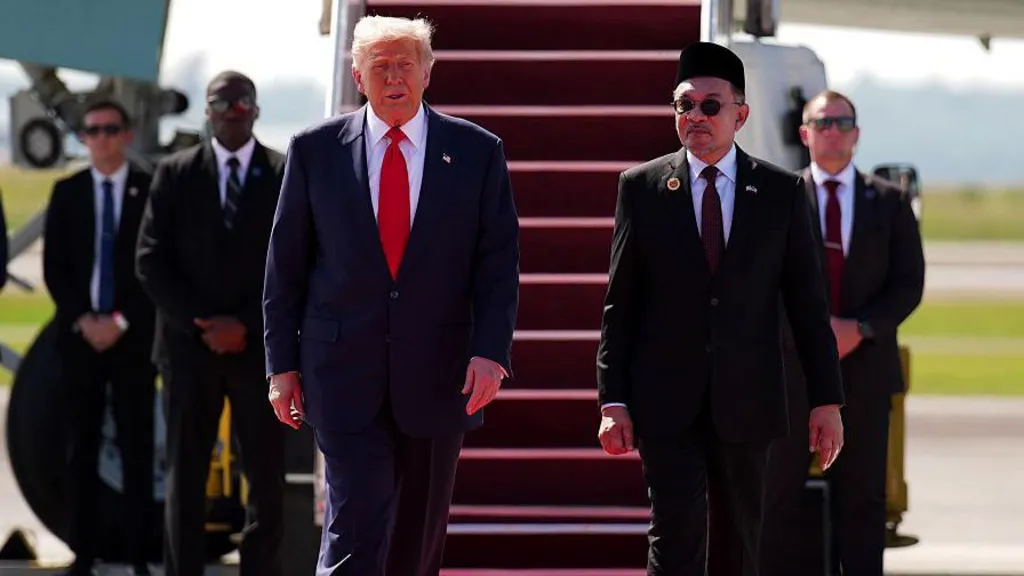
BBC Photo: President Donald Trump is greeted by Malaysian PM Anwar in Kuala Lumpur in October 2025
Source: BBC News
DST News: When US President Donald Trump stepped off his plane at Kuala Lumpur International Airport in October 2025, he was greeted by Malaysian Prime Minister Anwar Ibrahim — a man whose political journey from prison to premiership has become one of Southeast Asia’s most remarkable comeback stories.
“I was in prison but you almost got there,” Anwar quipped to Trump — a risky joke, met with a frosty smile. But behind the levity lay a moment of triumph: Anwar had just signed a tariff reduction deal with the United States, cutting levies on Malaysian exports from 24% to 19%, while also securing Trump’s participation in an ASEAN summit long dismissed as irrelevant.
At that summit in Kuala Lumpur, Trump presided over a high-profile “peace deal” between Thailand and Cambodia, a ceasefire that Anwar himself helped broker after months of deadly border clashes. Analysts hailed it as a diplomatic win for Malaysia — and a testament to Anwar’s growing influence on the regional stage.
Anwar’s rise has been anything but straightforward. Once a fiery student activist who founded the Islamic Youth Movement (ABIM), he shocked many by joining Malaysia’s ruling party UMNO in 1982. His charisma and intellect propelled him rapidly through the ranks, and by 1993, he was Deputy Prime Minister under Mahathir Mohamad, his political mentor turned rival.
Their fallout during the 1997 Asian financial crisis led to Anwar’s sacking and imprisonment on sodomy and corruption charges — accusations he insists were politically motivated. Freed in 2004, he reinvented himself as the face of Malaysia’s opposition, uniting diverse parties and nearly toppling the ruling coalition in 2013.
But in 2015, new charges sent him back to jail. His release came only after an unlikely reconciliation with Mahathir, who promised to hand over power after the opposition’s stunning 2018 election win. That promise never materialized, and Malaysia cycled through three prime ministers before Anwar finally took office in 2022.
Now 78, he has lasted longer than his three immediate predecessors — bringing a measure of political stability to a country long plagued by infighting.
Under Anwar, Malaysia has regained a reputation for relative calm, but economic frustrations are mounting. Inflation and rising living costs have sparked protests — including a 20,000-strong demonstration in July demanding his resignation. Big-ticket investments in semiconductors and data centres have yet to yield results, and critics say his economic reforms have been too slow.
He also faces cultural and religious tensions. A 2024 controversy erupted when socks bearing the word “Allah” were sold at a convenience store, sparking outrage and Molotov cocktail attacks. In 2023, a restaurant faced backlash over an employee’s crucifix necklace, highlighting Malaysia’s increasingly conservative religious climate.
“The political centre has shifted,” says Professor James Chin, an expert on Malaysian politics. “Anwar’s balancing act between Islamic conservatism and multiracial inclusion may push the country into uncharted territory.”
Adding to the pressure, 47 corruption charges were dropped against Anwar’s ally, the Deputy Prime Minister, fueling accusations of double standards in his anti-corruption drive.
Where Anwar has excelled is diplomacy. His deft handling of the Thailand-Cambodia ceasefire earned Malaysia new regional respect. He has also sought to keep Malaysia neutral in the growing US-China rivalry, welcoming both Trump and China’s Xi Jinping though Xi skipped this week’s ASEAN meeting.
“Trump’s visit was a major symbolic win,” says analyst Syaza Shukri of the International Islamic University Malaysia. “It showed that Malaysia remains relevant, and that Anwar can command international attention.”
Anwar’s pro-Palestinian stance has also resonated domestically amid public anger over the war in Gaza. But experts warn it could strain his ties with Washington, especially under Trump’s administration.
“Anwar needs to balance public sentiment with realpolitik,” notes Ariel Tan from Singapore’s S. Rajaratnam School of International Studies. “He can’t afford to alienate the US when tariffs and trade are at stake.”
Anwar’s challenge now is to translate his international credibility into domestic success. With elections due in 2028, his survival depends on whether Malaysians feel the stability he promises in global diplomacy reflects in their daily lives.
For now, his story remains that of a man who waited 25 years for power, endured two imprisonments, and now stands as one of the region’s most enduring and enigmatic leaders.
As one observer put it: “Anwar Ibrahim has gone from prisoner to peace broker — but his real test begins at home.”


