

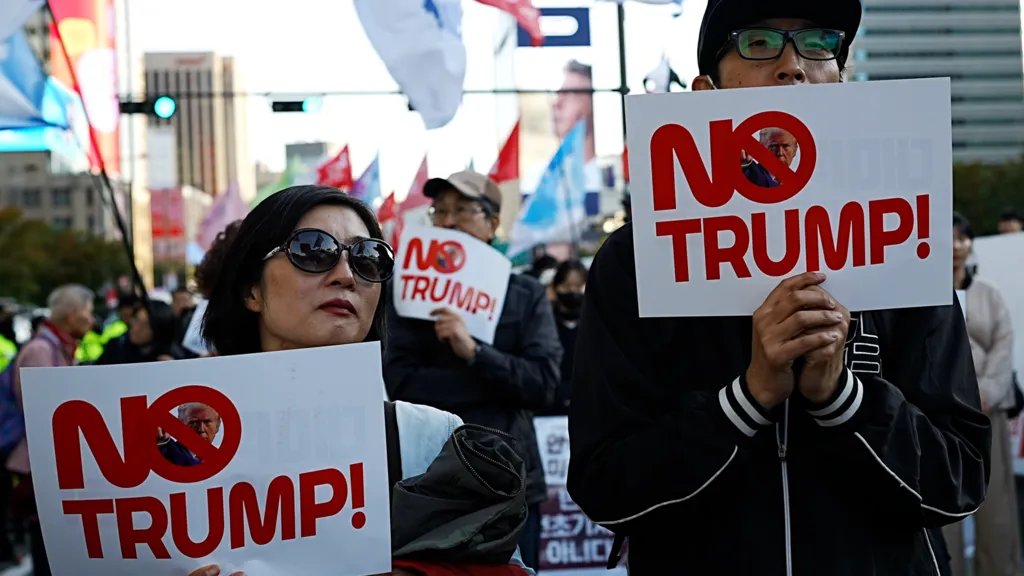
BBC Photo: Anti-Trump Protesters gathered in Seoul ahead of Trump’s arrival on Wednesday
Source: BBC
DST News: Crowds filled the streets of Seoul ahead of Donald Trump’s arrival on Wednesday, chanting “No Trump!” as they marched toward the US Embassy. Police buses blocked their path, but loudspeakers ensured their protest could be heard across Gwanghwamun Square.
A few hundred metres away, another rally sent a different message — “No China!” and “CCP Out!” Both demonstrations, though modest by South Korean standards, captured the deep diplomatic tension facing President Lee Jae-myung as he prepares to host both Donald Trump and Xi Jinping in Seoul this week.
South Korea’s long-standing alliance with the United States — forged during the Korean War — remains crucial to its defense. Yet China is its largest trading partner and a vital export market. That dual dependency places Seoul in an increasingly difficult position as global rivalry between Washington and Beijing intensifies.
“South Korea finds itself caught between a rock and a hard place,” says Darcie Draudt-Vejares of the Carnegie Endowment for International Peace. “President Lee is trying to balance the needs of both superpowers at a very precarious moment.”
A Delicate Diplomatic Balancing Act
President Lee, 61, assumed office after a period of national turmoil following the impeachment of his predecessor, Yoon Suk Yeol, whose brief declaration of martial law led to massive protests and division.
Initially, Lee’s charm offensive in Washington appeared successful. After his August visit to the White House, Seoul pledged to invest $350 billion in the US and purchase $100 billion worth of liquefied natural gas. In exchange, Trump agreed to reduce tariffs from 25% to 15%.
However, relations were strained when over 300 South Koreans were detained in a US immigration raid at a Hyundai plant in Georgia, unsettling one of South Korea’s largest global investors. Although most were released, the episode dented trust.
“It’s not a broken relationship, but it’s definitely eroding,” said Hye-yeon Lee, a 23-year-old protester in Seoul.
Trade negotiations have since stalled, with Trump demanding additional cash investments from Korean companies. Analysts believe a new agreement is unlikely during the current visit.
“Given the current impasse, the shorter Trump’s visit, the better for President Lee,” notes John Delury of the Asia Society. “If talks end quickly without confrontation, that might actually be the best-case scenario.”
Growing Anti-American and Anti-Chinese Sentiment
Despite widespread frustration, South Koreans still overwhelmingly view the US as their most important ally — nearly 90% expressed this in a Pew Research Center poll earlier this year, conducted before the Georgia raid. In contrast, only one-third see China favorably, viewing it as the greatest external threat.
At the protests, young South Koreans expressed anger over Trump’s transactional approach. College student Kim Sol-yi, 22, waved a banner depicting a cartoon Trump vomiting money. “When he called South Korea a ‘money machine,’ it infuriated me,” she said. “We’re being treated like a cash cow, not a partner.”
Meanwhile, a separate crowd rallied against Chinese influence. “I came out today to protect South Korea,” said Park Da-som, 27. “We should maintain diplomatic ties with China, but what we reject is the CCP’s interference.”
The China Challenge
Anti-Chinese sentiment has been simmering since 2016, when South Korea’s deployment of the US THAAD missile system angered Beijing, triggering economic boycotts. Distrust has only deepened, especially among conservatives, some of whom link China to alleged election meddling during Yoon’s impeachment crisis.
Protesters now carry banners reading “Korea for Koreans” and “Stop Chinese Boats.” A Seoul café even sparked outrage for refusing to serve Chinese customers — a move critics called racist, though protesters like Soo-bin, 27, disagreed.
“We stand for democracy and freedom — of speech, religion, and association,” she said. “That’s why we’re here.”
Walking a Diplomatic Tightrope
As Seoul hosts both Trump and Xi this week, President Lee faces one of the most complex balancing acts in South Korea’s modern history. His goal: maintain the nation’s economic and security ties with both powers without alienating either.
But as chants of “No Trump!” and “No China!” echo through the capital, it is clear that many South Koreans fear their country is being pulled in two opposing directions — and worry that, in the great-power tug of war, their own voice may be drowned out.


