

Source: BBC
DST News: Five days after Hurricane Melissa tore through western Jamaica with record-breaking winds, survivors in coastal towns remain stranded—cut off from help, without food, water, or electricity, and waiting desperately for relief.
Blocked roads, downed power lines, and mountains of debris have isolated large parts of the island. Authorities said at least 28 people have been confirmed dead, marking Jamaica’s worst natural disaster in decades. Officials fear the toll will rise as rescuers reach previously inaccessible areas.
Local administrator Dr Dayton Campbell told the BBC that 10 deaths occurred in Westmoreland Parish alone. Neighboring St Elizabeth, where the hurricane’s eye made landfall, reported near-total destruction—an estimated 90% of homes flattened.
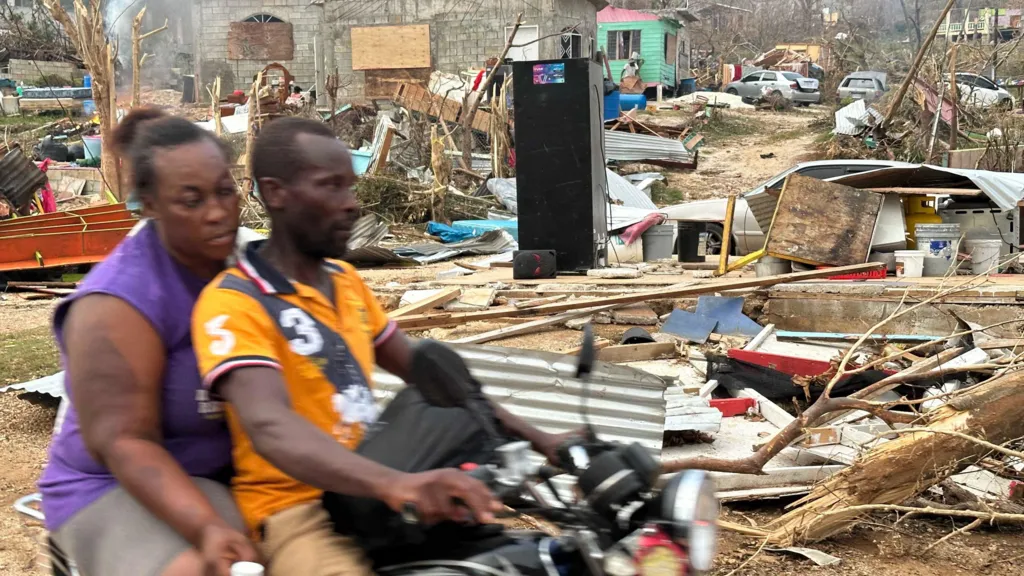
Driving west into Westmoreland now means passing through a wasteland of fallen trees and shattered buildings. Entire communities lie in ruins. Along the roads, residents clear debris with machetes while police convoys escort aid trucks through jammed streets. “We don’t know what lies ahead,” one officer said, describing “total devastation.”
In Whitehouse, a coastal town once bustling with trade, survivors say they have heard promises of aid but seen little action. “They no turn up,” said Gary Williams, sitting outside the remnants of a roofless building. Homeless after the storm, he said he may sleep outdoors.
Another resident described the situation as “horrible” and “hopeless,” saying people had been left with “no help, no food, no water.”
Power remains out for roughly 400,000 people, and many have lost access to phone networks and the internet. The government has deployed more than 200 Starlink satellite devices to restore limited connectivity.
Prime Minister Andrew Holness said the immediate priority is to clear debris, restore essential services, and deliver emergency food and medical aid. Transport Minister Daryl Vaz defended the government’s slow response, citing difficulties with refueling, landing access, and coordination.
In the wrecked fishing village outside Whitehouse, Robert Morris surveyed the ruins of his community. “Melissa take everything down,” he said. His boathouse and fishing boat were destroyed. “We just have to try and see what we can do.”
Despite the devastation, resilience runs deep. Roy Perry, sitting beneath a crumbling building, said: “We have to keep the faith and hope up still.” Nearby, farmer Oreth Jones sold the last of his crops—pears, pumpkins, and sweet potatoes—from the back of his truck. “It’s all wrecked,” he said of his farm, then added softly, “But we have to give God thanks we’re alive.”
International aid has begun to arrive. The U.S. Disaster Assistance Response Team reached Jamaica on Friday, while the United Kingdom and other nations have pledged millions of dollars in emergency relief.
For now, however, thousands of storm victims remain stranded in silence and ruin—holding on to faith, and waiting for help that has yet to come.


