

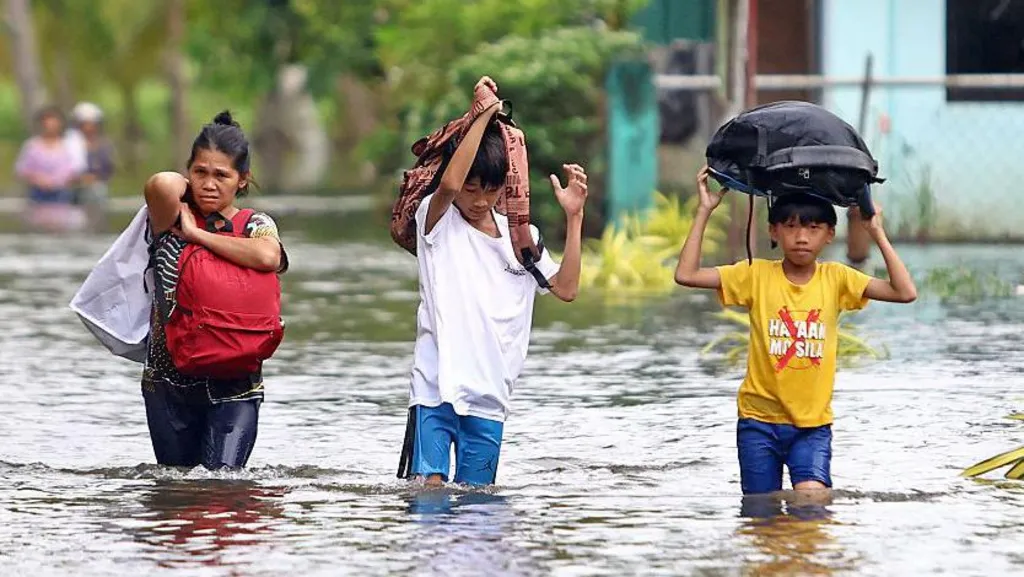
DST News: A powerful storm now classified as a super typhoon is sweeping toward the Philippines’ largest island, prompting widespread evacuations and emergency measures as officials warn of “life-threatening” conditions in several regions.
Typhoon Fung-Wong, locally called Uwan, is bringing sustained winds of around 185 km/h (115 mph) along with heavy rainfall, according to the national weather bureau Pagasa. The storm first struck parts of the Bicol region early Sunday, and is expected to move toward Luzon, the country’s most populated island, later in the day.
The arrival of Fung-Wong comes less than a week after Typhoon Kalmaegi devastated communities across the Philippines, leaving nearly 200 people dead and dozens more missing. Search and rescue operations in several provinces have been suspended due to the incoming storm.
Evacuations Underway
In eastern and coastal provinces, thousands of residents have been urged to move to higher ground. In Remedios T. Romualdez on the island of Mindanao, families packed belongings and left flooded homes as early rains lashed the area.
In Catanduanes, emergency officials reported extreme weather conditions by Sunday morning. Local governments have suspended in-person classes on Monday and moved them online, while Philippine Airlines cancelled several domestic flights as a precaution.
Fung-Wong is expected to weaken after landfall, though forecasters say it will likely remain a typhoon as it crosses Luzon.
Coastline on Alert
Along the coast of Aurora province, residents and businesses have spent days preparing. In the seaside town of Sabang, a hotel employee named Hagunoy, 21, told BBC News that police visited repeatedly to ensure all guests had evacuated ahead of the storm.
“Everyone has left,” he said, describing how staff tied shut windows with rope and secured gates against strong winds. He plans to stay a little longer before riding his motorbike inland to safety.
A Nation Still Reeling
Scenes of destruction from Typhoon Kalmaegi remain fresh. Rapid floods and landslides destroyed homes in poorer communities, and mudflows swept through residential areas. At least 204 people were confirmed dead in the Philippines, while five deaths were reported in Vietnam. Many of the missing are still unaccounted for.
The national government has declared a state of calamity, granting agencies greater authority to release emergency funds and accelerate the distribution of relief supplies ahead of this second major storm.
For many families, fear has overtaken fatigue.
“We evacuated because our community flooded badly during the last typhoon,” said Norlito Dugan, who is now sheltering with his family inside a church in Sorsogon. “This time, we just want to be safe.”
Another resident, Maxine Dugan, lives near the shoreline. “The waves are already huge. The winds are strong. We couldn’t stay,” she said.
Stronger Storms Likely Ahead
The Philippines, located along the Pacific cyclone belt, typically experiences around 20 tropical storms each year. While climate change is not believed to increase the number of storms, scientists warn that warming seas and rising global temperatures are fueling stronger and wetter cyclones, increasing the risk of flooding and coastal damage.
As Typhoon Fung-Wong continues its approach, emergency crews, volunteers, and local residents are racing against time, preparing for another night of high winds, heavy rain, and uncertain aftermath.
Source: BBC
Add Your Heading Text Here
Lorem ipsum dolor sit amet, consectetur adipiscing elit. Ut elit tellus, luctus nec ullamcorper mattis, pulvinar dapibus leo.


