

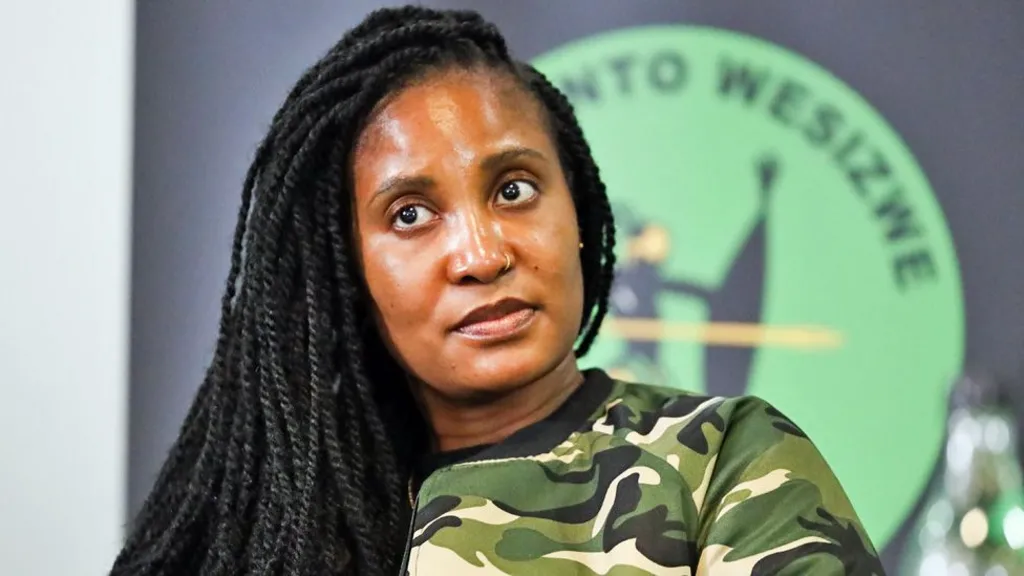
DST News: Duduzile Zuma-Sambudla, daughter of former South African President Jacob Zuma, has stepped down as a member of parliament following allegations that she played a role in sending young South African men to fight as mercenaries for Russia in the war in Ukraine.
She strongly denies the accusations, saying she believed the men were travelling for legitimate training programs.
Zuma-Sambudla, who entered parliament last year under the opposition uMkhonto weSizwe (MK) party, led by her father, said in an affidavit that she was misled and had no intention of recruiting anyone for combat. MK officials said her resignation was voluntary and aimed at helping secure the safe return of the stranded South Africans.
But for the families of the men stuck in Ukraine’s Donbas region, her departure offers little comfort.
The BBC spoke to the brother of one of the men, referred to as Sipho for his protection. He has been sending desperate voice notes from near the front line.
“Things you see in movies, we’re seeing live,” he says in one message. His brother, Xolani, who remains in South Africa, said the family now fears for Sipho’s life daily.
Sipho claims he was recruited by two people—including Zuma-Sambudla—and that his flights to Russia were paid for. He says he believed he was going for bodyguard training linked to the MK party. Instead, he ended up in eastern Ukraine under Russian command.
“When night approaches, he doesn’t know what will happen. They are always in a war zone,” Xolani told the BBC. “Her resignation means nothing to us. We want accountability and we want the men returned.”
According to families, the men travelled to Russia on 8 July and were later presented with contracts written entirely in Russian—a language they do not understand. Xolani says that when the group asked Zuma-Sambudla and another alleged recruiter for help, the pair travelled to Russia themselves. Their presence, he says, persuaded the men to sign.
By early August, the group had been moved to Ukraine and later split up. Sipho’s messages place him around 10km from the front line in Donetsk. In WhatsApp group chats seen by the BBC, the men describe drone attacks, fear, and uncertainty about their movements.
At one point, a user named “Duduzile Zuma-Sambudla” joined the WhatsApp group, urging the men to “hang in there” and assuring them efforts were underway to help them.
The case took another dramatic turn when Zuma-Sambudla’s half-sister, Nkosazana Zuma-Mncube, filed a police complaint accusing her of luring at least 17 men to Russia under false pretenses. Zuma-Sambudla has dismissed the allegation and filed a counter-complaint.
The Hawks, South Africa’s elite crime-fighting unit, confirmed that both cases are under joint investigation to determine whether offences such as illegal recruitment, human trafficking, exploitation or fraud took place.
In her affidavit—seen by the BBC—Zuma-Sambudla says she received non-combat training in Russia herself through a man she barely knew. She says she only “innocently” shared information about the program with others and did not realize anyone was being put in danger.
“I would not, under any circumstances, knowingly expose my own family or any other person to harm,” she wrote, saying she too feels “profound shock” at what unfolded and considers herself a victim of manipulation.
Earlier this month, the South African government confirmed it had received distress calls from 17 citizens trapped in Donbas after being deceived with promises of lucrative training contracts. Some reports suggest recruits also came from neighboring Botswana.
Officials said they would use diplomatic channels to bring the men home, but there has been no public confirmation of progress since.
Families remain in agony. Xolani says days often pass without contact.
“He goes off doing military stuff, and we don’t hear anything for five days,” he says. “We just want him back.”
In his latest message, Sipho pleads once again: “It’s tough here… we all just want to come home.”
Source: BBC


