

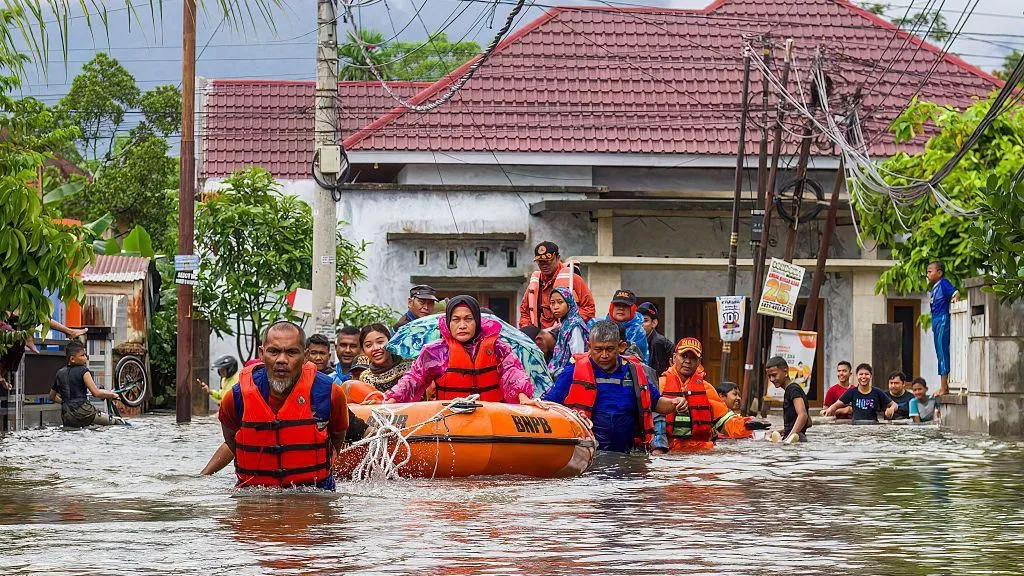
DST News: Search and rescue teams across Indonesia, Thailand and Malaysia are racing against time as severe monsoon rains — intensified by rare tropical storms — leave hundreds dead and many more unaccounted for across Southeast Asia.
The region has been hit by some of the heaviest rainfall in decades, triggering widespread flooding, landslides and massive displacement. Millions have been affected, and authorities warn that the scale of the disaster is still unfolding.
Indonesia has suffered the brunt of the destruction, especially on the island of Sumatra where more than 300 people have been confirmed dead. Dozens remain missing as rescuers struggle to reach isolated communities cut off by collapsed roads and damaged communication lines. Electricity and internet access have been only partially restored.
The floods were worsened by Cyclone Senyar, an exceptionally rare storm that ripped through the region, sweeping away homes and submerging thousands of buildings.
“In seconds, the water rushed into the streets and then into the houses,” said Arini Amalia from Aceh Province, describing how she fled with her grandmother to higher ground. When she returned the next day, her home was completely submerged. Another resident in West Sumatra said he survived only by clinging to a clothesline as the floodwaters pulled him away.
In the badly hit district of Tapanuli, shortages have led desperate residents to break into grocery stores in search of food. Several local leaders and humanitarian groups are urging Jakarta to declare a national disaster to speed up assistance.
Thailand is also facing enormous losses. The government reports more than 160 deaths across 10 southern provinces. Songkhla province alone saw waters rise as high as 3 metres, killing at least 145 people. More than 3.8 million people have been affected.
In Hat Yai, one of the hardest-hit cities, authorities recorded 335mm of rain in a single day — the highest rainfall there in three centuries. As waters receded, the death toll jumped sharply. With morgues overwhelmed, hospital workers moved bodies into refrigerated trucks for temporary storage.
“We were stuck in the water for seven days, and no one came to help,” resident Thanita Khiawhom told BBC Thai.
Thai officials have promised financial support, including compensation of up to two million baht (about $62,000) for families who lost loved ones. Tens of thousands have taken refuge in emergency shelters.
Malaysia’s casualty numbers remain far lower, but the devastation is extensive. In northern Perlis state, entire areas have been submerged. Two deaths have been confirmed and tens of thousands have evacuated to temporary shelters.
Elsewhere in South Asia, Sri Lanka is grappling with the aftermath of Cyclone Ditwah. More than 130 people have been killed and around 170 are missing, prompting the government to declare a state of emergency. About 15,000 homes have been destroyed, and nearly a third of the country is without water or electricity.
Meteorologists say the exceptional flooding across Southeast Asia may be linked to the interaction between Typhoon Koto in the Philippines and Cyclone Senyar, which unusually formed inside the narrow Malacca Strait.
While monsoon rains are a yearly occurrence, experts warn that climate change is intensifying storm patterns, contributing to heavier rainfall, more frequent flash floods and stronger winds across the region.
Source: BBC


