

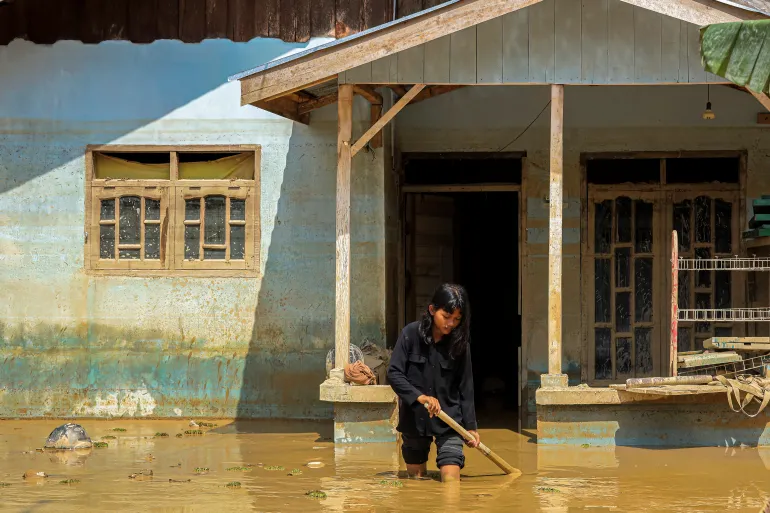
DST News: Torrential rains continue to lash parts of Asia, creating new dangers and slowing rescue operations. The combined death toll from floods and landslides in Indonesia, Sri Lanka and Thailand has now risen to more than 1,750 people, according to officials and humanitarian groups.
In Indonesia, the situation remains the most severe. Authorities in Aceh province on the island of Sumatra confirmed at least 908 deaths. Another 410 people are still missing. More than 800,000 residents have been displaced as communities struggle to cope with waterlogged roads, collapsed bridges and thick mud.
In the devastated region of Aceh Tamiang, the landscape has changed entirely. Whole villages were swept away. Survivors wandered through knee-deep mud on Friday, searching for family members and belongings. Governor Muzakir Manaf warned that hunger is becoming the biggest threat. He told reporters that many remote communities have received no aid at all. According to him, people are now dying from starvation and not only from the floodwater.
Sri Lanka is facing one of the most difficult national emergencies in its recent history. The government has confirmed 607 deaths. Another 214 people remain missing and are feared dead. Nearly two million people across the country have been affected. The Disaster Management Centre reported that more than 71,000 homes were damaged, including almost 5,000 that were completely destroyed. Heavy rain is expected to continue in many districts, including the already devastated central region. Officials warned that new landslides may occur and that ongoing cleanup efforts will be slowed significantly.
Thailand has recorded at least 276 deaths caused by the floods. Malaysia and Vietnam reported two deaths each after intense rainfall triggered a series of landslides.
Indonesia’s meteorological agency warned that Aceh, North Sumatra and West Sumatra could experience very heavy rainfall through Saturday. This forecast has raised fears that already weakened hillsides may collapse. Search teams are still retrieving bodies in areas where floodwaters buried entire neighbourhoods in mud.
For many survivors, the most immediate concern is the lack of food and clean water. Some villages remain completely isolated. Relief workers say the shortage of supplies is becoming critical.
Scientists have noted that the disaster followed an unusual combination of two typhoons and a cyclone that passed through the region at the same time. Experts told Al Jazeera that extreme rainfall events of this kind are becoming more likely as global temperatures rise.
Environmental degradation has magnified the impact. Illegal logging, much of it linked to palm oil plantations, has stripped Sumatra of large areas of rainforest. These forests once helped absorb excess rainfall. Photographs from affected areas show logs and uprooted trees piled up along riverbanks.
The Indonesian government has begun taking action. Forestry Minister Raja Juli Antoni announced that the ministry is cancelling the logging permits of twenty companies, covering an area of about 750,000 hectares. Environment Minister Hanif Faisol Nurofiq also ordered an immediate halt to palm oil, mining and power plant activities upstream from several flood-stricken areas in northern Sumatra. He said that the Batang Toru and Garoga watersheds have critical ecological and social importance that must be protected.
Environmental health expert Febi Dwirahmadi from Griffith University in Australia told Al Jazeera that intact rainforest cover works like a natural sponge that absorbs water during heavy rainfall. He added that losing this protective layer increases the likelihood of future disasters.
Source: Aljazeera


