

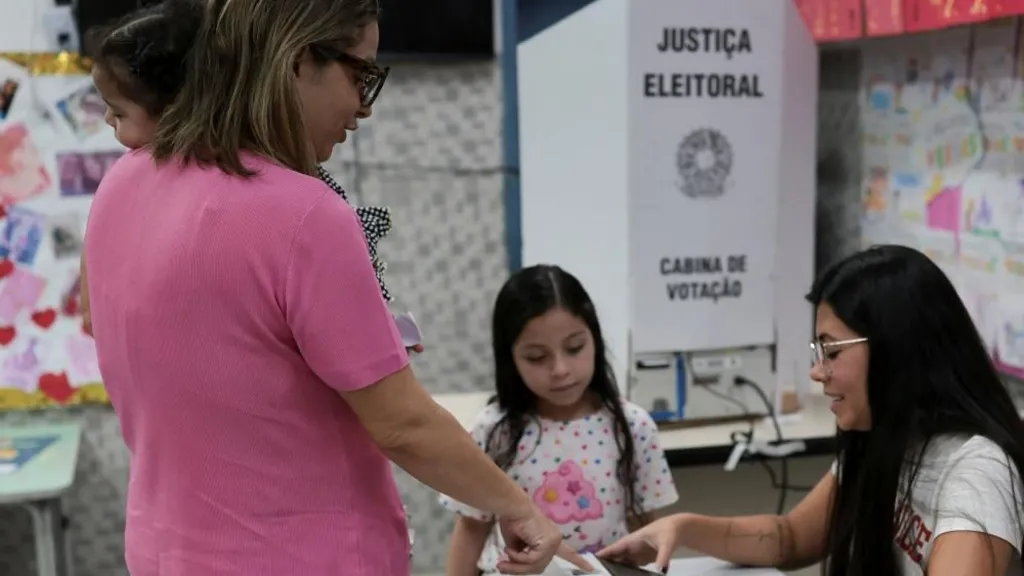
DST News: Right-wing candidate Flávio Bolsonaro has won the first round of Brazil’s presidential election, narrowly defeating incumbent President Luiz Inácio Lula da Silva but failing to secure the majority needed to win outright.
The two candidates will face each other in a run-off on 25 October.
With almost all votes counted, Bolsonaro received about 47% of the vote, compared with 45% for Lula. Bolsonaro’s performance exceeded expectations after Lula had led slightly in opinion polls during the campaign.
Flávio Bolsonaro, 45, is the eldest son of former President Jair Bolsonaro, who is serving a 27-year prison sentence over his role in a failed attempt to overturn the 2022 election result. Jair Bolsonaro was barred from seeking re-election and endorsed his son as his political successor.
Flávio has promised to grant his father and supporters convicted over the 8 January 2023 riots an amnesty if he becomes president.
His Liberal Party (PL) also performed strongly in congressional and gubernatorial elections, potentially giving it significant influence in Congress.
The election has again highlighted Brazil’s deep political divisions. Lula, 80, represents the left, while Bolsonaro has campaigned on conservative positions concerning crime, national sovereignty, the economy and corruption.
Lula remains particularly popular among lower-income voters and in Brazil’s poorer northeast, while Bolsonaro has stronger support in the south, among wealthier voters and evangelical Christians.
After voting, Lula described the choice facing Brazilians as one between democracy and what he called “barbarism”. Bolsonaro said he wanted to “free the Brazilian people”.
Lula acknowledged that the first-round result was unexpected but insisted that the election was not over. Bolsonaro, meanwhile, expressed confidence that he would win the second round.
The election has also focused heavily on crime and public security. Bolsonaro has proposed designating major Brazilian gangs as terrorist organisations and constructing maximum-security prisons based on El Salvador’s model.
The economy is another major issue. Lula has defended his social welfare programmes, including Bolsa Família, which provides financial support to low-income families while encouraging children to remain in education and receive healthcare.
Bolsonaro has proposed limits on public debt, reductions in government spending, changes to social welfare programmes and greater investment in Brazil’s critical-minerals sector.
Foreign policy has also featured prominently. Lula has emphasised Brazil’s national sovereignty and has accused the United States of attempting to influence Brazilian politics, an allegation Washington has denied. A Bolsonaro presidency would likely bring Brazil closer to the United States and its regional efforts to combat organised crime and drug trafficking.
The second-round vote on 25 October will therefore determine whether Brazil continues under Lula’s left-wing leadership or moves towards a government led by Flávio Bolsonaro and the conservative Liberal Party.


