

By Prof Dr Md Momtazur Rahman,
Bangladesh’s history is marked by moments of extraordinary political upheaval, but few have generated as much debate as 7 November 1975. Emerging from a period of uncertainty, military unrest and political confrontation, the events of that day became a defining episode in the country’s post-independence history. For many, 7 November represented a turning point that reshaped the direction of the state and opened a new chapter in national politics.
The years immediately following independence in 1971 were exceptionally difficult. The country faced economic devastation, widespread poverty, political instability and the enormous challenge of rebuilding institutions. The famine of 1974 further deepened public suffering. Meanwhile, the introduction of the one-party BAKSAL system in 1975 restricted political pluralism and intensified opposition to the government. Allegations of repression and abuses by the security forces added to public discontent.
The political situation deteriorated further amid confrontational politics, including growing tensions between the government, opposition groups and elements within the armed forces. Bangladesh was struggling to establish stable democratic institutions while confronting economic hardship and competing political ambitions.
The assassination of President Sheikh Mujibur Rahman and most of his family members on 15 August 1975 plunged the country into another phase of political uncertainty. This was followed by the military c oup of 3 November, led by Brigadier Khaled Mosharraf, which removed General Ziaur Rahman from his position as army chief and placed the military establishment in further turmoil.
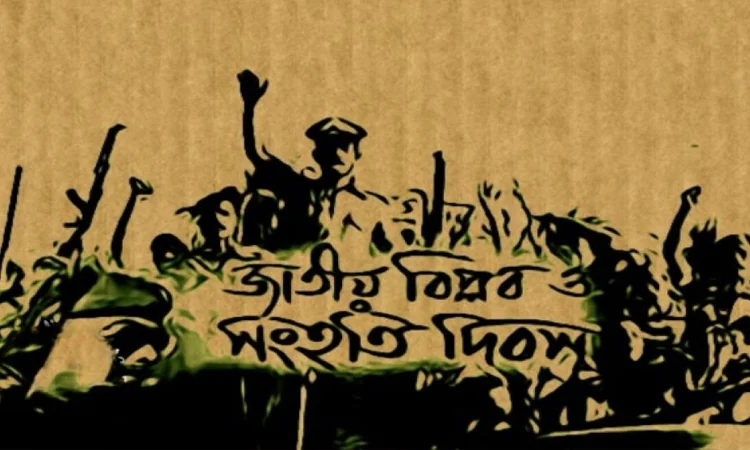
Against this turbulent backdrop, 7 November witnessed another dramatic reversal. Soldiers and civilian supporters mobilised in the capital, leading to the release of General Ziaur Rahman from house arrest and his emergence as the central figure in the subsequent political transition. Colonel Abu Taher and elements associated with the Jatiya Samajtantrik Dal (JSD) played an important role in the uprising.
The events of 7 November were therefore not simply a military development. They reflected a broader struggle over the future direction of Bangladesh. While different political groups subsequently interpreted the uprising according to their own ideological positions, its consequences were far-reaching. Ziaur Rahman gradually consolidated his authority and became the dominant political figure in the country. Colonel Taher was later arrested and executed in 1976, adding another controversial dimension to the legacy of the uprising.
Ziaur Rahman’s subsequent leadership introduced significant changes in the country’s political and economic direction. His administration emphasised national unity, economic recovery and greater participation of the private sector. Moving away from the highly centralised economic approach associated with BAKSAL, the government encouraged private investment, agricultural development, industrial expansion and foreign economic cooperation.
The expansion of non-governmental development activities also became an important feature of Bangladesh’s development landscape. Organisations working in rural development, poverty reduction, education and healthcare gained greater opportunities to operate. These initiatives contributed to the gradual expansion of employment opportunities and the growth of community-based development programmes.
Agriculture received renewed attention, while policies encouraging private entrepreneurship helped diversify economic activities. Bangladesh also began strengthening its engagement with international development partners. Although these developments had multiple contributing factors and cannot be attributed to a single political event or administration, the period marked an important transition in the country’s economic policy.
Political developments were equally significant. Ziaur Rahman introduced a multiparty political framework, allowing previously restricted political organisations to resume activities. The Awami League returned to politics, while other parties, including Jamaat-e-Islami, also regained the opportunity to participate in political activities. This reopening of political space marked a departure from the one-party arrangement introduced in 1975.
However, the restoration of multiparty politics did not immediately establish a fully democratic system. Bangladesh continued to experience military influence, restrictions on political freedoms and institutional instability. The political legacy of General Ziaur Rahman’s administration must therefore be assessed through both its contributions and its limitations.
The international context also helps explain the significance of this period. During the 1970s, military governments dominated several countries across Latin America, Africa and the Middle East. Brazil, Chile and Argentina experienced prolonged periods of military rule, while authoritarian governments exercised considerable influence in other parts of the developing world. Against this background, Bangladesh’s gradual movement towards a multiparty political framework was an important development, although its democratic institutions remained fragile.
Ziaur Rahman’s popularity was closely connected to his role in the Liberation War. His declaration of independence over the radio in March 1971 had made him a prominent national figure. His military background, wartime leadership and subsequent political initiatives helped him establish a strong public following. For many supporters, he represented a leader capable of restoring order and providing a new direction at a time of national uncertainty.
Nevertheless, the historical significance of 7 November should not be reduced to the political fortunes of one individual or party. It was a complex event shaped by military rivalries, ideological differences, public grievances and the struggle for political authority. Its interpretation remains contested, and a mature understanding of history requires acknowledging these different perspectives.
Fifty-one years after independence, Bangladesh continues to face fundamental questions about democracy, national unity, economic justice and institutional accountability. The experience of 1975 offers an important lesson: political exclusion, concentration of power and institutional weakness can push a nation towards prolonged instability. Sustainable progress requires constitutional governance, respect for democratic rights and meaningful participation by all sections of society.
Ultimately, 7 November 1975 remains a significant turning point in Bangladesh’s political journey. Its enduring importance lies not merely in the emergence of a new political leadership but also in the questions it raises about the nature of power, national unity and democratic governance. Bangladesh’s future must be built on the lessons of its past, with a commitment to pluralism, accountability and the collective aspirations of its people.
The writer is a registrar and professor of English at IUBAT-International University of Business Agriculture ad Technology. He can be reached at momtazur@iubat.edu.