

DST News: A state minister’s claim that gifts voluntarily offered by contractors to government engineers from their profits should not be considered bribes has sparked controversy, with existing government service rules and provisions of the Penal Code placing restrictions on public officials accepting such benefits.
State Minister for Local Government, Rural Development and Cooperatives Mir Shahe Alam recently said that gifts willingly given by contractors to engineers from their profits should not be treated as bribes and that engineers could accept them. His remarks have drawn criticism from concerned citizens and the anti-corruption watchdog Transparency International Bangladesh (TIB).
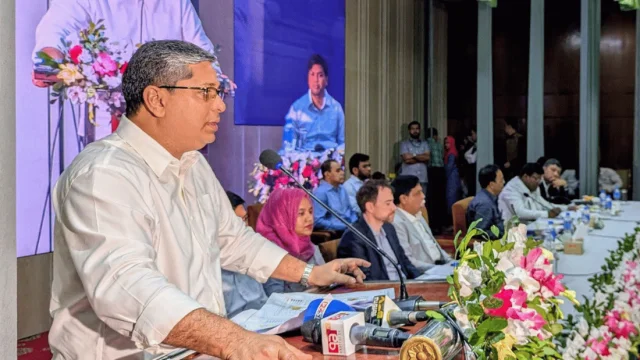
The minister made the comments while attending the inauguration of an orientation and training programme for newly appointed assistant engineers of the Local Government Engineering Department (LGED) at the LGED auditorium in Dhaka on Tuesday.
His statement has raised questions about the legality of government officials receiving personal gifts from contractors whose work they supervise or whose interests may be affected by their official decisions.
What the conduct rules say
Rule 5 of the Government Servants (Conduct) Rules, 1979, sets out restrictions on government employees accepting gifts.
Under Rule 5(1), a government servant cannot accept a gift without prior government approval from anyone with whom they have official dealings or whose interests could be affected by accepting the gift, except under specific circumstances permitted by the rules.
This means public officials cannot automatically consider gifts from contractors as personal gestures of goodwill, particularly when those contractors have official dealings with them. The relevant conditions and approval requirements must be followed.
Sub-rule 5(4) also establishes monetary limits for gifts that certain categories of officials may accept. In a statement to the media, TIB Executive Director Dr Iftekharuzzaman referred to a Tk500 limit applicable to gifts received by secretaries or officials of equivalent rank from specified sources.
Meanwhile, Clause 6(2) of Schedule 20 of the Public Procurement Rules, 2025, permits the distribution of low-value promotional items, such as diaries, calendars and pens bearing an organisation’s logo, with a maximum value of Tk5,000 per item.
However, analysts say this provision does not give government officials general permission to accept personal gifts from contractors.
High Court lawyer Habibur Rahman told Dhaka Tribune that government employees are governed by the 1979 conduct rules, which restrict the acceptance of gifts where doing so could create an obligation or expectation of favour in the performance of official duties. These restrictions also extend to family members of government employees.
What the Penal Code says
Accepting benefits beyond legally authorised remuneration in exchange for performing official duties may also constitute a criminal offence under the Penal Code.
Section 161 provides for punishment when a public servant accepts gratification beyond their lawful remuneration in return for performing an official act or showing favour in the exercise of official responsibilities.
Section 165 also provides for punishment when a public servant accepts a valuable item, either without payment or for inadequate consideration, from someone whose business or affairs are connected to the official duties of that public servant.
Legal experts say that calling a benefit a gift does not automatically make it lawful. The purpose of the gift, the relationship between the giver and recipient, and its connection to the recipient’s official responsibilities are all relevant considerations.
Habibur Rahman described the state minister’s remarks as entirely unlawful, arguing that they amounted to legitimising and encouraging bribery and corruption.
Questioning the idea that contractors would voluntarily reward engineers simply out of appreciation, he said an investigation might reveal that a contractor who willingly gives an engineer a gift has never even given one to their own parents out of happiness.
TIB: Remarks could legitimise bribery
TIB has strongly criticised the minister’s comments, saying that encouraging engineers to accept gifts from contractors in connection with their official responsibilities amounts to promoting bribery and corruption.
TIB Executive Director Dr Iftekharuzzaman pointed out that government engineers are responsible for inspecting the quality of construction work, formally accepting completed projects and ensuring that contractors’ bills are paid promptly in accordance with regulations.
He said engineers already receive salaries and benefits from public funds to carry out these responsibilities.
“Why, then, should they need to receive illegal benefits from contractors in the name of gifts in exchange for performing their official responsibilities?” he asked.
Iftekharuzzaman said advising officials responsible for preventing irregularities in public procurement to earn money outside established rules from contractors at the beginning of their careers was extremely irresponsible and unlawful.
He warned that comments of this nature from a state minister could encourage demands for bribes at the field level and contribute to the spread of corruption.
He also called on the minister to publicly identify the law or regulation that permits government officials to receive personal benefits from contractors’ profits as rewards for performing their routine duties.
Ministry rejects TIB’s allegations
The Ministry of Local Government, Rural Development and Cooperatives has rejected TIB’s criticism of the state minister’s remarks, describing the organisation’s interpretation as “untrue and misleading”.
In a clarification issued in response to TIB’s November 11 press release, the ministry said the minister had instructed newly appointed LGED assistant engineers to carry out government development projects efficiently and transparently while maintaining required quality standards.
According to the ministry, he urged engineers to ensure the quality of work, rise above personal relationships and make payments to contractors in accordance with established procedures. It added that he had emphasised strict compliance with the Public Procurement Rules (PPR) and Public Procurement Act (PPA) in government spending and procurement.
The ministry alleged that “a certain group” had taken remarks made during an informal conversation between the minister and newly appointed assistant engineers out of context, while ignoring the substance of his official address. It said portraying his comments as an attempt to legitimise bribery amounted to undesirable political propaganda against the government’s anti-corruption position.
The ministry reiterated that the government remained committed to transparency, accountability and a zero-tolerance policy towards corruption. It added that holding a responsible public position did not provide anyone with an opportunity to receive unlawful benefits outside established procedures.
It further said that on Wednesday morning, November 11, the state minister had expressed regret and apologised to the media for remarks he made the previous day during a workshop involving municipal administrators, chief executives and engineers at the LGED Bhaban.
According to the ministry, he had also withdrawn those informal remarks and clarified that no government official was associated with them.
The ministry urged everyone to support the government’s efforts to prevent corruption rather than create confusion over the minister’s statement. It also called on media professionals to cooperate in eliminating corruption from government activities and strengthening transparency and accountability.
Source: Dhaka Tribune