

DST News: Bangladesh, Bhutan and Nepal have called for continued access to predictable, grant-based climate finance even after graduating from the least developed country (LDC) category, warning that development progress does not eliminate their vulnerability to climate change.
Representatives from the three countries also called for stronger regional cooperation to tackle shared climate threats, including Himalayan glacier retreat, changing monsoon patterns, transboundary river flows, extreme weather, rising sea levels and saltwater intrusion.
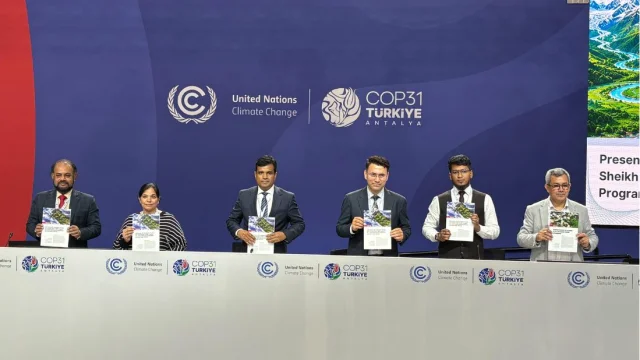
The demands were raised at a press conference titled “From Shared Vulnerability to Resilience in BBN: Advancing Adaptation and Finance Priorities at COP31”. The event was organised by the Centre for Participatory Research and Development (CPRD), in collaboration with the Climate Justice Alliance–Bangladesh (CJA-B), at the COP31 venue in Antalya on Saturday.
Government representatives, climate specialists and civil society organisations from Bangladesh, Bhutan and Nepal attended the event to advocate for a vulnerability-focused approach to climate adaptation and financing under the United Nations climate negotiations.
Speakers highlighted that despite differences in geography and economic conditions, the three countries face interconnected climate risks as part of a shared mountain-to-delta system. They said these challenges require coordinated regional responses rather than separate national strategies.
Moderating the discussion, CPRD Chief Executive Md Shamsuddoha said graduating from the LDC category should not be seen as graduating from climate vulnerability.
He called for greater flexibility in accessing international climate finance after graduation, arguing that development achievements should not prevent countries from securing the resources needed to adapt to climate change.
In his keynote presentation, Sheikh Nur Ataya Rabbi, programme manager for research and advocacy at CPRD, emphasised the need for a joint Bangladesh-Bhutan-Nepal (BBN) agenda on climate adaptation and financing at COP31.
He said coordinated regional advocacy and a common position were essential to ensure that the international community recognises both the individual vulnerabilities of the three countries and their shared climate risks.
Dr Shah Abdul Saadi, joint secretary at the Economic Relations Division (ERD) under Bangladesh’s Ministry of Finance, said climate-related weather events were becoming more frequent, intense, prolonged and unpredictable, with impacts spreading across the Ganges-Meghna-Brahmaputra (GMB) basin.
He noted that many vulnerable communities and geographical areas continue to receive inadequate attention and support because of shortcomings in vulnerability mapping, risk assessments, institutional responsibilities and resource allocation.
Saadi stressed the need for cross-border cooperation among civil society organisations to strengthen advocacy, generate evidence for policymaking and develop institutional mechanisms to address climate risks across national boundaries.
He also called for compatible early warning systems across the region, noting that their effectiveness depends not only on coverage but also on whether vulnerable communities can access and use them.
He urged countries to mobilise financial and technological resources at a scale and pace that match the growing climate threats.
Manjeet Dhakal, head of the LDC Support Team and director of Climate Analytics South Asia, described Bangladesh, Bhutan and Nepal as an interconnected mountain-to-delta climate development corridor linked through the Himalayas and the Ganges-Brahmaputra-Meghna basin.
He said the region’s shared climate challenges could not be adequately addressed through individual country-based strategies.
Instead, he proposed recognising BBN as a regional adaptation hub, with financing and planning based on actual vulnerabilities and adaptation needs.
Md Ziaul Haque, additional director general (PRL) of the Department of Environment under Bangladesh’s Ministry of Environment, Forest and Climate Change, also called for continued international assistance after LDC graduation.
He said graduation represents development progress, not the disappearance of climate vulnerability, and urged stronger alignment between national adaptation priorities and climate finance under the United Nations Framework Convention on Climate Change (UNFCCC).
Haque emphasised that grant-based assistance should be maintained through financing arrangements that take future climate risks and countries’ fiscal capacities into account.
He also called for international funding to reach nationally identified and costed adaptation priorities on appropriate terms, supported by coordinated regional advocacy.
Ruchi Chaudhary, programme manager at Climate Action Network South Asia (CANSA), urged governments and civil society organisations across the three countries to pursue a coordinated, vulnerability-focused adaptation agenda.
She said Bangladesh, Bhutan and Nepal had demonstrated sustained climate leadership despite facing serious vulnerabilities and limited resources.
Referring to the BBN Alliance’s advocacy at COP28, COP29 and COP30, she highlighted the need for cross-border risk monitoring, early warning systems, locally led adaptation, transparent climate finance delivery and accountability to vulnerable communities.
She also called for aligning adaptation priorities with low-carbon development pathways under Nationally Determined Contributions (NDCs) and Long-Term Low-Emission Development Strategies (LT-LEDS).
Three key demands
The press conference outlined three major policy priorities for Bangladesh, Bhutan and Nepal at COP31 and beyond.
The first is to place vulnerability-centred adaptation at the forefront of global climate negotiations, ensuring that financial support reflects equity, human rights and the interconnected risks facing the three countries.
The second is to guarantee continued access to adequate, predictable, accessible and grant-based adaptation finance after LDC graduation. Speakers said future funding arrangements should be determined by actual and projected climate vulnerabilities, national adaptation needs and fiscal capacities, rather than development classifications alone.
The third is to strengthen regional cooperation through a common BBN advocacy and negotiating agenda. This would include collaboration on early warning systems, locally led adaptation, transparent climate finance distribution and accountability.
Concluding the discussion, speakers urged governments, civil society organisations and international development partners to work towards a fairer global adaptation framework that recognises climate vulnerability beyond economic and development categories.
They warned that countries should not lose access to essential climate assistance simply because they have achieved a higher development status, particularly when their communities continue to face growing climate threats.
The report was produced under the COP31 Climate Change Media Partnership, a journalism fellowship organised by Internews’ Earth Journalism Network, Informed Earth and the Stanley Centre for Peace and Security.
Source: Dhaka Tribune