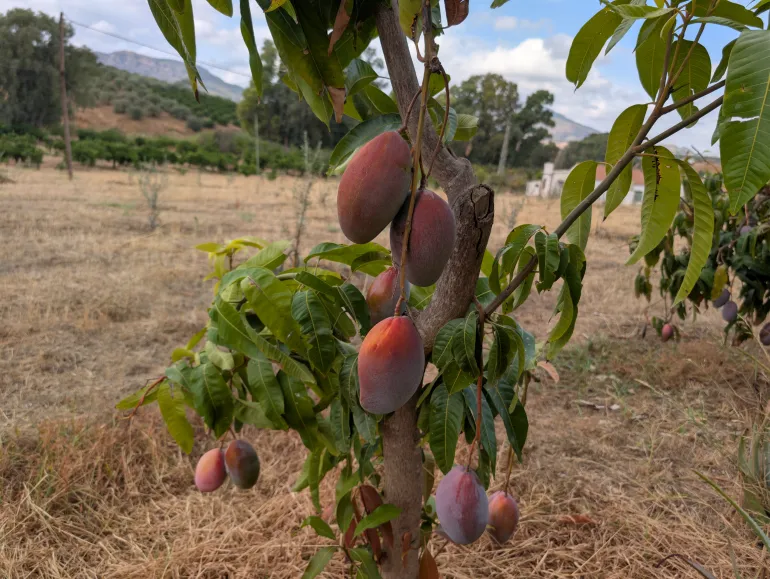
The property covers 14 hectares (35 acres) and contains nearly 400 olive trees. Henrietta hopes to expand the grove to 1,000 trees, reflecting her commitment to sustainable living and the preservation of the countryside. The surrounding landscape, with its olive groves, orange trees, mangoes and rugged mountains, provides a peaceful setting for the project.
For Henrietta, however, Andalucía offers more than natural beauty. Having lived in Britain since 2001, she says she has often felt like an outsider despite spending more than two decades there. In Spain, she experiences a different sense of belonging, with neighbours who know her as an individual rather than primarily through her religious identity.
Her relationships with local residents illustrate the importance of everyday interactions in building mutual understanding. One of her neighbours, Juan Garcia, supplies her with lemons, avocados and honey and sometimes helps with the olive harvest. Their friendship reflects a practical form of cooperation that crosses religious and cultural boundaries.
A visit to Juan’s family home offers another example. His 79-year-old mother, Maria, asks Henrietta about the scarf covering her hair. Henrietta explains that wearing it is part of her Muslim faith and a way of expressing her closeness to God. Maria, a Catholic, draws a connection with the Virgin Mary, who is also traditionally depicted with her head covered. Their conversation develops naturally, with both women recognising that kindness and good character matter more than outward religious differences.
Such experiences have helped Henrietta feel at home in Andalucía. She believes that community relationships are built through ordinary encounters rather than political arguments, and that people can maintain different beliefs while treating one another with dignity and respect.
Her attachment to southern Spain is also rooted in its historical significance. The region formed the heartland of Al-Andalus, the name given to Muslim-ruled territories of the Iberian Peninsula during the medieval period. For nearly eight centuries, Muslim dynasties governed parts of present-day Spain and Portugal, leaving a lasting influence on architecture, agriculture, science, scholarship and language.
Cities such as Córdoba, Seville and Granada preserve important reminders of this history. Their architectural heritage includes horseshoe arches, intricate geometric tilework, decorative plasterwork and Arabic calligraphy. Traditional irrigation systems, including channels known as acequias, also reflect the region’s historical connections with Arabic-speaking societies.
The Muslim legacy extends beyond monuments. Arabic contributed numerous words to the Spanish language, particularly in agriculture, architecture and everyday life. Place names and local traditions also preserve traces of centuries of cultural interaction. Although Muslim political rule in Granada ended in 1492, its cultural and intellectual influence continued to shape the Iberian Peninsula.
British Muslim travel writer and historian Tharik Hussain, author of Muslim Europe, explains that Al-Andalus occupies a distinctive place in the Muslim imagination. Its disappearance from Muslim political control has contributed to an enduring sense of nostalgia, reflected in historical writing and poetry across generations.
For contemporary Muslims, Andalucía therefore represents both a historical connection and an opportunity to reconsider the relationship between Islam and Europe. Some are drawn to the region by its architecture and cultural heritage, while others see it as a place where they can practise their faith and establish a meaningful connection with local society.
Nevertheless, modern Spain is not simply a continuation of its medieval past. Like other European countries, it faces political divisions, economic pressures and debates about immigration, national identity and religious diversity. The far-right Vox party has made opposition to immigration and what it describes as the “Islamisation” of Spain part of its political campaign, raising concerns about the social acceptance of Muslim communities.
Henrietta recognises that being Muslim can bring challenges in different parts of the world. Yet she prefers to concentrate on the relationships and community she can build rather than allow political developments to determine her everyday life. For her, faith, friendship and cooperation provide a foundation for belonging even when wider political circumstances remain uncertain.
The House of Andalus embodies this approach. By combining the preservation of the natural environment with an interest in Islamic history, Henrietta and Ajmal hope to create a space for learning, reflection and cultural exchange.
Their experience also highlights a broader question about Muslim identity in Europe. Al-Andalus is often remembered as a period of remarkable cultural achievement, but contemporary Andalucía is a living society with diverse identities and its own complex relationship with history. Reconnecting with the past requires an appreciation of its heritage without overlooking the realities of modern life.
For Henrietta, the aim is not to recreate a vanished civilisation but to draw inspiration from its legacy while building relationships in the present. Her life in the mountains near Álora demonstrates how historical memory, religious faith and everyday neighbourliness can come together to create a sense of home.
As more Muslims explore the possibility of settling in southern Spain, Andalucía offers both a connection to an important chapter in Islamic history and a chance to participate in contemporary European society. Whether that promise can withstand changing political attitudes remains an open question, but Henrietta’s experience suggests that meaningful connections often begin at the local level, through simple acts of kindness, cooperation and mutual respect.