DST News: A record 33 members have been expelled from China’s Communist Party as it concluded a major political gathering, which saw the lowest attendance in its history.
The fifth plenary session, or plenum, was attended by 279 Central Committee members, compared with 315 at the fourth plenum in October 2025 and 364 at the third in July 2024.
Unlike previous gatherings, which largely focused on economic reforms and social development, this week’s meeting placed party discipline at the centre of discussions.
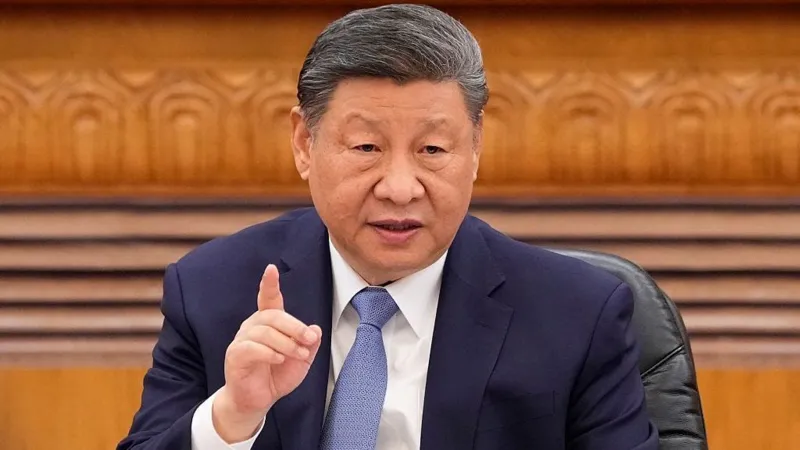
Chinese President Xi Jinping has made tackling corruption a key priority since taking power in 2012, describing it as the “biggest threat” to the Communist Party.
Since then, more than two million people have faced disciplinary action over issues including “pointless formalities, bureaucratism, hedonism and extravagance”, Zhang Fuhai of the party’s disciplinary commission said at a press briefing on Friday.
He added that the party would strengthen efforts to ensure officials “dare not, cannot, and do not want to be corrupt”.
Anti-corruption campaign continues
Of the 33 members expelled, 16 were from the military, according to a communique released on Thursday following the four-day closed-door meeting at a hotel in Beijing.
The specific charges against the expelled members remain unclear, beyond the official description of “serious disciplinary and legal violations”. Such broad allegations have become common in Xi’s anti-corruption campaign.
Chong Ja Ian, a non-resident scholar at Carnegie China, said the campaign had increasingly become a means of consolidating and maintaining political authority.
He argued that its continuation and expansion would depend more on how secure Xi felt in his position than on the actual extent of corruption.
In its statement, the party acknowledged that its leadership had at times been weakened or undermined. It pledged to maintain strict internal discipline and continue its efforts to address misconduct within its ranks.
The latest expulsions bring the total number of party members removed during Xi’s third term to 51, compared with 35 in his first term and five in his second.
Meanwhile, China’s top anti-corruption watchdog reported that 680,000 people across the party apparatus had faced disciplinary action during the first nine months of this year.
The meeting also marked the first time in Xi’s 14 years as China’s leader that attendance at a plenum had fallen below 300. The current Central Committee began its term in 2022 with more than 370 members.
Observers say Xi views corruption not only as financial misconduct but also as ideological disloyalty and a failure to follow party directives.
In January, he warned against “two-faced cadres” who publicly demonstrate political loyalty but secretly disregard orders and pursue their own interests.
Who are the key figures purged?
Among the senior officials expelled are former Xinjiang Communist Party chief Ma Xingrui and former top generals Zhang Youxia and Liu Zhenli.
Official statements announcing their removal this year said they had “seriously violated [the party’s] discipline and rules”, a phrase widely interpreted as referring to corruption allegations.
The removal of senior military figures has been particularly significant. Neil Thomas, Lobsang Tsering and Shengyu Wang of the Asia Society Policy Institute described the scale of the military purge as “in a category of its own”.
They said the developments raised serious questions about China’s military leadership and combat readiness, despite the country’s continued introduction of advanced military equipment.
Zhang Youxia previously served as vice-chairman of the Central Military Commission, which oversees China’s armed forces. The seven-member commission has now been reduced to just two members: Xi, as chairman, and Zhang Shengmin, as vice-chairman.
Ma and Zhang Youxia were also former members of the Politburo. Their removal, together with that of former general He Weidong in 2025, left the powerful 24-member Politburo with only 21 members at one point.
Zhang Shengmin was promoted to the top decision-making body during the fifth plenum, increasing its membership to 22.
Former senior diplomat Liu Jianchao, who disappeared from public view in July last year, was also identified among those purged.
Chong said Xi had shown little hesitation in removing officials he had personally promoted, adding that his ability to do so with limited opposition highlighted the strength of his current position.
Xi’s plans for the future
Analysts believe the increased emphasis on party discipline, which many interpret as a demand for political loyalty, is partly linked to next year’s Communist Party Congress, when the party will select its next leadership.
A major leadership reshuffle is expected in 2027, with many analysts anticipating that Xi will seek to remain in power for a fourth term or longer. If he does, he would become the first Chinese leader since Mao Zedong to serve for such an extended period.
Thomas said the removal of so many officials from the current Central Committee would likely prompt Xi to examine the next generation of potential leaders more closely.
He noted that emerging political figures tend to be relatively young, have technical and professional backgrounds, and maintain connections with Xi’s political network. Provincial leadership positions, he added, could be an important source of future candidates.
Observers expect Xi to retain significant influence over personnel appointments at the 21st Party Congress, further strengthening his control over the Communist Party and the country.
Chong said the latest developments indicated that Xi intended to remain at the centre of China’s political system for the foreseeable future.
However, he warned that the concentration of power around one leader could create a more serious leadership vacuum as Xi grows older and eventually becomes less active.
Source: BBC