Bangladesh’s education system is facing a critical challenge that requires urgent national attention. Despite the expansion of schools, colleges, universities, and enrolment opportunities, the country continues to struggle with declining educational outcomes, graduate unemployment, and a growing mismatch between academic qualifications and labor-market requirements. The situation raises a fundamental question: Is the education system adequately preparing young people for employment, professional development, and the challenges of the modern world?
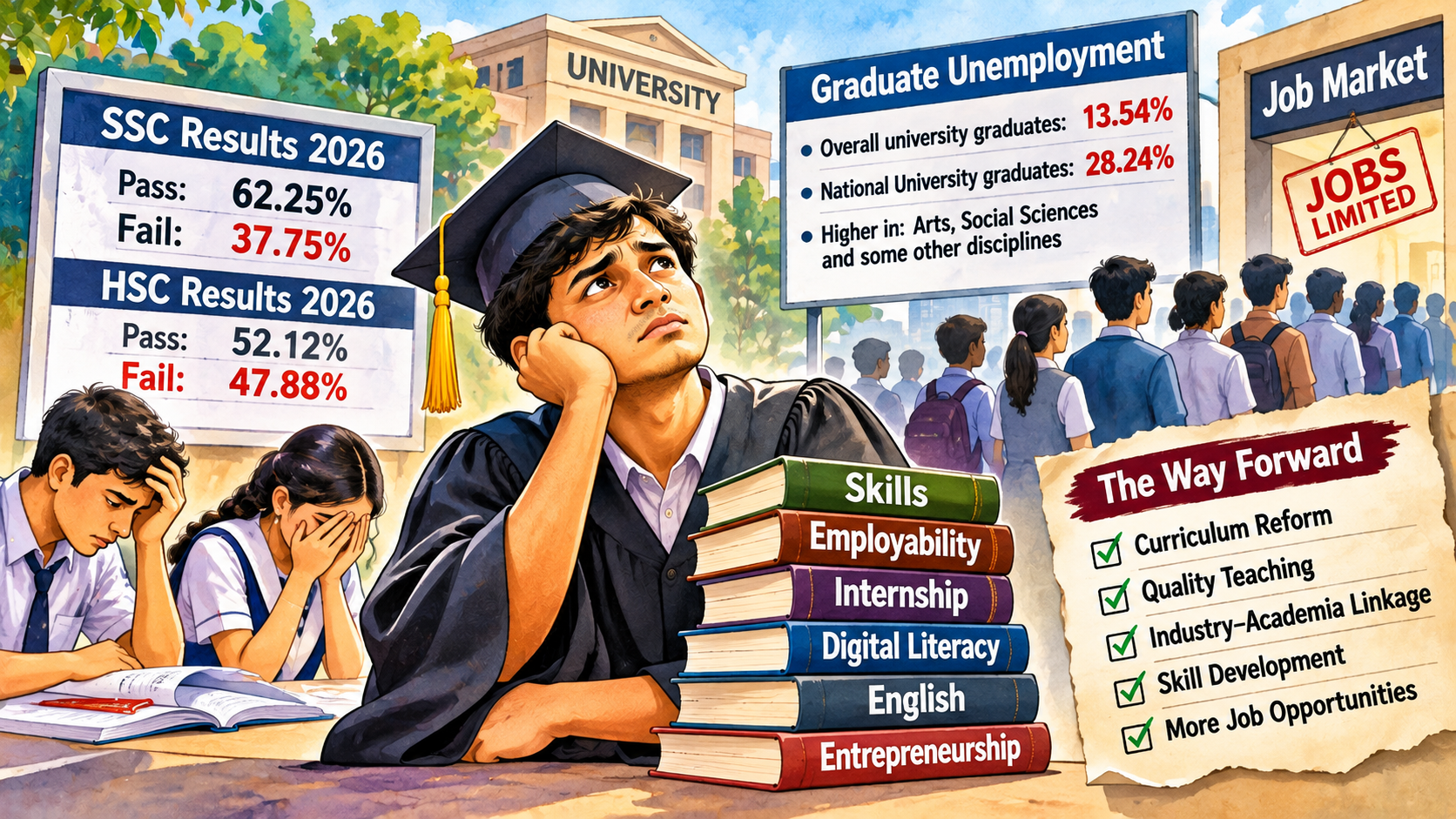
The results of the 2026 Secondary School Certificate (SSC) and Higher Secondary Certificate (HSC) examinations have intensified these concerns. The SSC pass rate fell to 62.25%, while the HSC pass rate stood at only 52.12%. Consequently, hundreds of thousands of students failed to achieve the expected results. These figures should serve as a serious warning to policymakers, education administrators, curriculum developers, and teachers. When such a large proportion of students fail public examinations, the reasons must be investigated beyond individual student performance.
One important concern is the effectiveness of existing syllabuses, curriculum development, teaching methodologies, and examination systems. Frequent changes in academic programs, insufficient teacher preparation, inadequate classroom resources, and an excessive emphasis on memorization may contribute to weak learning outcomes. However, these factors require systematic investigation rather than assumptions. Students should be encouraged to develop analytical thinking, creativity, communication skills, and practical knowledge instead of preparing primarily to reproduce textbook information in examinations.
The graduate unemployment situation is equally alarming. According to the Bangladesh Bureau of Statistics’ Labor Force Survey 2024, approximately 885,000 university graduates were unemployed, representing an unemployment rate of 13.54% among university-educated people. A separate Bangladesh Institute of Development Studies (BIDS) study found that 28.24% of surveyed graduates from National University-affiliated colleges were unemployed. These statistics demonstrate that obtaining a university degree does not necessarily guarantee access to suitable employment.
The problem is closely connected to the mismatch between higher education and the changing needs of the economy. Many graduates complete their degrees without adequate practical experience, professional communication skills, digital competencies, or exposure to workplace environments. Employers increasingly seek candidates who can apply their academic knowledge to real-world problems. Unfortunately, conventional teaching and assessment practices do not always provide students with these opportunities.
The challenge also varies across academic disciplines. Graduates in humanities, social sciences, business studies, and science-related subjects face different employment opportunities and professional requirements. However, this does not mean that certain disciplines should be considered less valuable. Humanities and social sciences, for example, contribute significantly to critical thinking, communication, social understanding, ethical awareness, and responsible citizenship. The real priority should be to ensure that students from all disciplines acquire transferable skills and appropriate professional competencies.
Universities and colleges must therefore reconsider their academic priorities. Curricula should be reviewed regularly in consultation with employers, professional organizations, industry representatives, and academic experts. Internship programs, research activities, practical assignments, entrepreneurship education, and industry-based training should become integral components of undergraduate programs. Higher education institutions should also strengthen career counselling and employment support services to help graduates make informed professional choices.
English language proficiency and digital literacy deserve particular attention. In an increasingly interconnected world, students need effective communication skills to participate in international education, research, business, and professional activities. Similarly, practical ICT education should prepare graduates to work with emerging technologies, artificial intelligence, data analytics, and other digital tools. These competencies should not remain optional additions to academic programs; they should become essential elements of modern education.
Another major concern is the quality difference between educational institutions in urban and rural areas. Many colleges and schools outside major cities face shortages of qualified teachers, modern laboratories, libraries, digital facilities, and appropriate learning resources. These inequalities create unequal educational opportunities and affect students’ academic performance. The government must ensure that educational investment reaches disadvantaged institutions and communities.
The government should establish an independent national education review commission to examine the reasons behind the poor SSC and HSC results in 2026, assess the effectiveness of existing curricula, and investigate the persistent unemployment of university graduates. The commission should recommend evidence-based reforms involving curriculum development, teacher training, examination systems, institutional accountability, and graduate employability.
At the same time, the private sector must become a stronger partner in educational development. Businesses and industries should collaborate with universities to provide internships, apprenticeships, graduate trainee programs, and practical training opportunities. Government initiatives should also encourage young graduates to pursue entrepreneurship and establish innovative businesses rather than depending exclusively on conventional public- and private-sector employment.
Bangladesh cannot achieve sustainable economic development by simply increasing the number of degree holders. The country needs an education system that produces competent professionals, innovative thinkers, responsible citizens, and skilled entrepreneurs. Educational success should not be measured exclusively by examination results, graduation numbers, or the expansion of institutions. It should also be assessed through learning quality, professional competence, employment opportunities, research contributions, and the ability of graduates to serve society.
The 2026 SSC and HSC results, together with the alarming unemployment statistics among university graduates, should be treated as an opportunity for meaningful reform. Blaming students, teachers, or individual institutions will not resolve the underlying problems. What Bangladesh needs is a coordinated national commitment involving policymakers, educators, parents, employers, and educational institutions.
A university degree should open doors to opportunity, not become a source of frustration and unemployment. Bangladesh must transform its education system from one that primarily awards certificates into one that develops knowledge, skills, creativity, and professional competence. The future of the nation depends not on how many students graduate each year, but on how effectively they can contribute to the economy, society, and national development.
The writer is a Professor of English and Registrar at IUBAT-International University of Business Agriculture and Technology. He can be reached at momtazur@iubat.edu.