

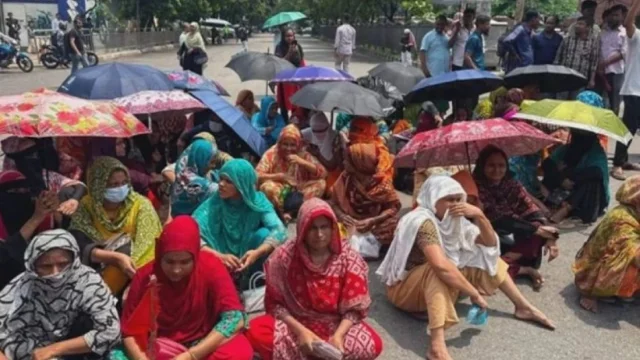
DST News: Owners of 210 garment factories in Ashulia, Jamgora and Hemayetpur are considering shutting down their operations indefinitely as labour unrest, production disruptions and security concerns continue amid workers’ demands for a higher minimum wage.
A preliminary decision to close the factories was taken at an emergency meeting on Wednesday. A final decision is expected at a meeting of all members on Saturday, Sparrow Group Managing Director Shovon Islam said.
Industry sources reported that production was suspended at 143 factories across the three areas on Wednesday. In several units, workers arrived for duty but refused to work, while some marked their attendance and then left. A number of factories also reported vandalism, and production at some units remained suspended for as many as 11 consecutive days.
Seven factories in Savar and Ashulia have already been declared closed indefinitely under Section 13(1) of the Bangladesh Labour Act, 2006. The affected units include three factories of Arunima Group, three of Newage Group and one of Jeans Manufacturing Company Ltd.
Meanwhile, protests over wage demands continued on Thursday. Workers from several factories blocked the Dhaka-Tangail highway in the Mouchak area of Kaliakair, Gazipur, causing lengthy traffic congestion. Police and Border Guard Bangladesh personnel used sound grenades to disperse the demonstrators. Following the incident, owners announced holidays at eight to nine factories in and around Mouchak.
Industrial Police-1 Superintendent Mohammad Mominul Islam Bhuiyan said most factories in Ashulia remained operational on Thursday, although workers at some units left after marking their attendance. Law enforcement agencies continued patrols and surveillance in the area.
The unrest comes as the newly formed minimum wage board considers workers’ demands. At its second meeting, the workers’ representative proposed a monthly minimum wage of Tk32,000. The employers’ representative is expected to present a counterproposal at the board’s third meeting on Monday.
Bangladesh Garment Manufacturers and Exporters Association (BGMEA) President Mahmud Hasan Khan said wage negotiations could not proceed alongside disorder. He said factory owners were willing to resolve the issue through discussions but emphasised the importance of maintaining normal production and workplace discipline.
The ongoing disruptions are creating financial difficulties for both workers and factory owners. Workers risk losing wages and working days, while owners must continue paying factory rent, utility bills, loan instalments and other operating expenses even when production is halted.
There are also concerns that shipment delays could lead international buyers to demand discounts, cancel orders or move future business to other countries.
Shovon Islam said transferring production to subcontracting factories would not necessarily address the problem, as buyers often have specific requirements regarding factory facilities, production processes and quality control. Delayed shipments could also force exporters to rely on expensive air freight or risk losing orders.
Former BGMEA director and Bangladesh Apparel Voice CEO Mahiuddin Rubel said production disruptions affect both workers and businesses. He warned that continued instability could damage Bangladesh’s reputation as a sourcing destination.
CPD Distinguished Fellow Dr Fahmida Khatun called for regular dialogue, transparent wage-setting and effective grievance mechanisms. She said fair wages and safe working conditions must be balanced against production costs and the industry’s international competitiveness. She also stressed that international buyers should ensure fair prices for garments.
Source: Dhaka Tribune