

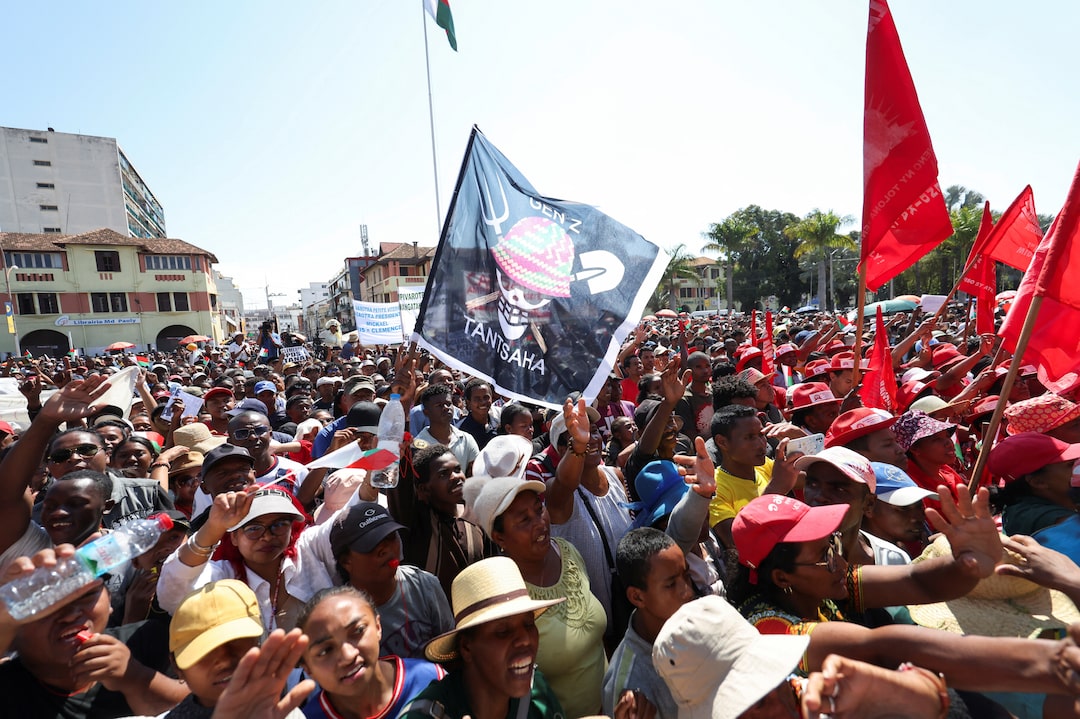
Reuters Photo: A person joins others holding a flag featuring a Malagasy version of the logo from the popular Japanese manga One Piece, in Antananarivo, Madagascar.
Source: Reuters
DST News: When an elite army colonel joined Madagascar’s Gen Z-led protests earlier this month, forcing the president to flee, youth leader Olivia Rafetison initially felt relieved to have military protection after weeks of state violence.
“He told us, ‘We’re with the people. We’ll help you. We’re on your side,’” she recalled, describing how demonstrations over water and power shortages evolved into a full-blown revolt against President Andry Rajoelina.
Days later, the same colonel, Michael Randrianirina, declared the army was taking control of the country.
“What started as protecting the people turned into taking power,” said Rafetison, 28, speaking in central Antananarivo. “I’m not entirely against it… but I’m conflicted.”
Randrianirina was sworn in as interim president on Friday, just three days after seizing control following the unrest that ousted Rajoelina. He announced that the military would govern alongside civilians for up to two years before holding new elections.
Gen Z: Reform the System, Not Just the Leader
Rafetison, who heads the Movement Gen Z Collective — a coalition of protest groups — is not alone in her mixed feelings about a military takeover. Many young activists fear their voices could once again be sidelined.
On the night of the coup, Randrianirina met with Rafetison and other youth leaders. “He said, ‘We’re listening to you,’” she said, though the conversation was brief as soldiers were exhausted. “I hope they follow through,” she added. “This isn’t over — our fight is for systemic change, not just swapping one president for another.”
Madagascar’s youth — with an average age of just 19 — face mounting hardships due to decades of poor governance by older male leaders. Even Rajoelina, once the world’s youngest president at 34 when he came to power through a coup in 2009, failed to improve living conditions or deliver reliable public services.
According to World Bank data, Madagascar’s GDP per capita has nearly halved since independence from France in 1960, one of the few countries to grow poorer over time. Repeated periods of military or military-dominated rule have often ended in economic disaster.
In the capital’s crowded, uneven streets, poverty is visible everywhere — from street vendors selling trinkets to families begging for food.
“Everyone exploits the system without caring. Even if people starve, it means nothing to them,” said Alicia Andriana from the Association of Dynamic Malagasy Students (Assedu-Mada), speaking from a downtown nightclub that doubles as a Gen Z meeting spot.
“We Asked for Water, Electricity, and Food”
Andriana expressed cautious gratitude for the army’s intervention but remained unsatisfied. “We asked for water, electricity, for every family to have enough to eat,” she said. “The military needs to establish a system that can truly change life in Madagascar.”
However, not all youth groups share her patience. A Facebook community called Gen-Z Tonga Saina, with 18,000 members, warned Thursday that the army “serves the system, not the people.” The group did not respond to requests for comment.
Ketakandriana Rafitoson, Vice Chair of Transparency International and one of the protest organizers, acknowledged that coups undermine democracy but said this one emerged amid “a total unwillingness of political leaders to address grievances,” followed by violent crackdowns and the president’s sudden flight with no viable civilian successor.
“In reality, the military was the only organized force capable of halting the violence and reopening civic space,” she explained.
Still, Madagascar’s emboldened youth movement remains wary.
“We can’t be sure they’ll listen — but we hope they will,” said 23-year-old Gen Z spokesperson Tolotra Andrianirina.
And if not?
“We’ll go back to the streets,” he said. “We’ve done it once. We can do it again, if we have to.”


