

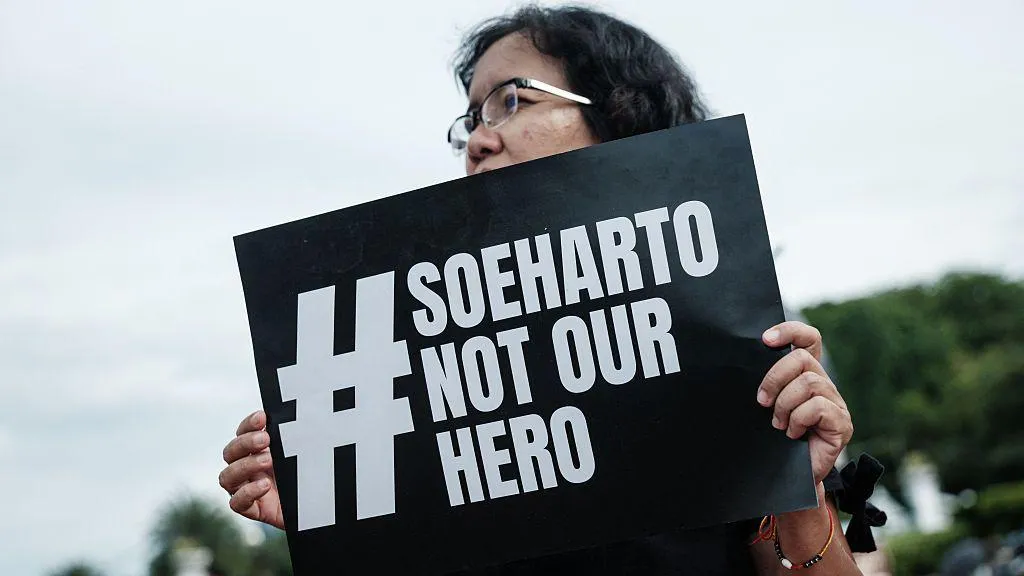
DST News: Indonesia has added former president Suharto to its official list of national heroes, a decision that has immediately reignited long-running public divisions over his legacy.
Suharto, who ruled Indonesia for more than three decades until 1998, oversaw a period of fast economic growth and large-scale development. But his time in power was also marked by widespread human rights abuses, political repression and mass killings of suspected leftists in the mid-1960s. Estimates of the death toll range into the hundreds of thousands.
Despite this history, Suharto was among 10 figures honored in a ceremony at the presidential palace in Jakarta on Monday. The event was led by President Prabowo Subianto, a former army general and Suharto’s onetime son-in-law. His children attended to receive the award on his behalf.
Government officials highlighted Suharto’s role in Indonesia’s independence era, pointing to his involvement in disarming Japanese troops during a key battle in 1945.
However, the decision has triggered strong opposition. Civil society groups, students and activists have condemned the move as an attempt to recast Suharto’s authoritarian rule in a favorable light. Last week, protesters gathered in central Jakarta, and more demonstrations were expected on Monday, with security forces deployed across the capital. An online petition opposing the hero title has gathered tens of thousands of signatures.
Amnesty International Indonesia criticized the award as “an effort to whitewash the crimes of the New Order regime” and warned of a broader push to rewrite historical memory.
Suharto’s rule (1967–1998) saw strict limits on political freedoms, the jailing and disappearance of critics, and one of the most violent military occupations of the Cold War era when Indonesia invaded East Timor. Yet his government also delivered economic growth averaging around 7% a year and brought down runaway inflation. Supporters still refer to him as Bapak Pembangunan, or “father of development”, though he was also widely accused of massive corruption.
The award is especially sensitive given President Prabowo’s own controversial military past. He has faced long-standing allegations of involvement in the abduction and torture of pro-democracy activists in the late 1990s, near the end of Suharto’s rule. Thirteen activists taken during that period remain missing.
At the same ceremony, other honorees included former president Abdurrahman Wahid — widely known as Gus Dur — and Marsinah, a factory worker and labor rights activist murdered in 1993. Both were prominent critics of authoritarianism, making their inclusion appear to some as an effort to soften the reaction to Suharto’s recognition.
For many Indonesians, memories of Suharto remain deeply mixed. Some recall economic stability under his leadership; others remember the fear and violence. The new title ensures that debate over his legacy will continue — and intensify — in today’s Indonesia.
Source: BBC


