

By Prof Dr Md Momtazur Rahman,
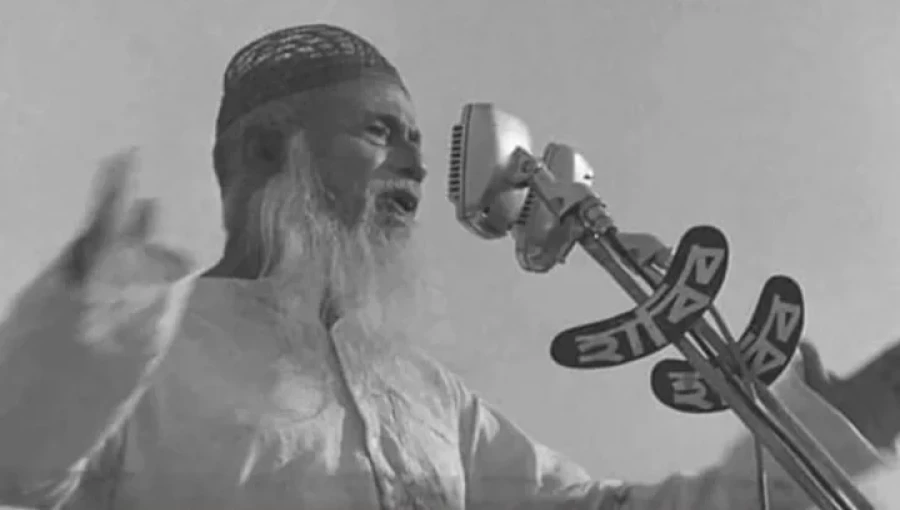
On the 50th death anniversary of Maulana Abdul Hamid Khan Bhashani, Bangladesh remembers one of the most uncompromising political leaders in its history. Popularly known as Majlum Jananeta (Leader of the Oppressed), Bhashani devoted his life to challenging exploitation, opposing injustice and defending the rights of peasants, workers and marginalised communities.
His political journey was shaped by an extraordinary commitment to social justice and people’s emancipation. Unlike many political leaders who sought influence through positions of power, Bhashani drew his strength from the masses. His politics was rooted in the struggles of ordinary people, particularly those living in poverty and deprived of political and economic rights.
Born on December 12, 1880, in Dhangara village of Sirajganj, Bhashani grew up to become a formidable voice against colonial domination, feudal exploitation and economic inequality. His early involvement in the Khilafat and Non-Cooperation movements brought him into the mainstream of anti-colonial politics. However, his greatest political contribution emerged from his ability to organise marginalised communities and transform their grievances into collective movements.
His struggles in Assam, particularly against the discriminatory Line System, established him as a champion of peasants’ rights. He mobilised landless farmers and challenged the power of landlords and exploitative interests. His commitment to the rural poor earned him the enduring title of Majlum Jananeta.
Following the partition of the subcontinent in 1947, Bhashani became a central figure in the political struggle for the rights of the people of East Bengal. On June 23, 1949, he played a leading role in establishing the East Pakistan Awami Muslim League and became its founding president. At a time when the ruling establishment in West Pakistan sought to consolidate political and economic control over the eastern wing, Bhashani emerged as a determined advocate of autonomy and democratic rights.
The historic Kagmari Conference of February 1957 remains one of the most significant episodes in his political career. Held in Tangail, the conference exposed the growing political and economic contradictions between East and West Pakistan.
Bhashani strongly opposed the unequal distribution of national resources and the political domination of East Pakistan. His famous farewell expression, “Assalamu Alaikum”, directed towards the West Pakistani ruling establishment, symbolised the depth of his political disillusionment.
The conference also helped articulate the aspirations for self-determination that would eventually contribute to the emergence of an independent Bangladesh. Later that year, he founded the National Awami Party (NAP), providing an organisational platform for progressive, anti-imperialist and left-oriented political forces.
Bhashani’s political significance extended beyond party politics. He consistently challenged authoritarianism, economic exploitation and the suppression of democratic rights. During Ayub Khan’s military rule in Pakistan, he became one of the prominent leaders of resistance.
His contribution to the mass uprising of 1969 was particularly important. While students and political activists mobilised against military dictatorship, Bhashani helped energise the wider movement by bringing ordinary people into the struggle. His political approach demonstrated that democratic movements could not succeed without the participation of peasants, workers and the economically disadvantaged.
His commitment to Bangladesh’s independence during the Liberation War of 1971 was equally significant. He firmly supported the cause of independence and worked to mobilise international opinion against the atrocities committed by the Pakistani occupation forces. He was also associated with the advisory council of the Bangladesh government-in-exile.
Even after the emergence of Bangladesh as an independent state, Bhashani did not retreat from public life. He continued to speak against poverty, inequality, administrative failures and the deprivation of ordinary citizens.
One of the most remarkable demonstrations of his political determination was the historic Farakka Long March on May 16, 1976. At an advanced age, he led thousands of people towards the Indian border to protest against the adverse effects of the Farakka Barrage and demand Bangladesh’s rightful share of the Ganges waters.
The march was more than a protest over water distribution. It represented a broader assertion of national rights, environmental security and the legitimate interests of a downstream country. It also demonstrated his ability to transform a complex international issue into a powerful popular movement.
Fifty years after his death, Bhashani’s political philosophy deserves renewed attention. Bangladesh has undergone profound political, economic and social transformations since his passing. Yet many of the problems against which he struggled remain relevant: economic inequality, rural poverty, concentration of wealth, exploitation of workers, institutional weaknesses and the marginalisation of disadvantaged communities.
His legacy should not be confined to commemorative speeches, political slogans or annual floral tributes. Remembering him meaningfully requires examining the principles that guided his political life.
Bhashani believed that politics should serve people rather than individuals or vested interests. He never considered political leadership merely a route to authority or personal advancement. His austere lifestyle and close association with ordinary people distinguished him from many conventional political figures.
Equally important was his insistence on an independent political voice. He was willing to challenge powerful political establishments, including those with which he had previously been associated. His disagreements with political leaders demonstrated his unwillingness to compromise on fundamental questions of autonomy, equality and national interest.
His politics also reflected a distinctive combination of religious conviction, social justice and anti-imperialist consciousness. He demonstrated that religious identity and concern for economic equality need not be contradictory. His appeal crossed conventional political boundaries because he consistently addressed the material conditions of ordinary people.
One of the greatest challenges in remembering Bhashani is to recognise his contribution beyond contemporary political divisions. Different political groups have attempted to associate themselves with his legacy. However, his historical significance belongs to the entire nation.
He was not simply a political leader of a particular party or ideological movement. He was part of the broader struggle that shaped the political consciousness of the people of this region—from resistance against colonial rule to the demand for autonomy and ultimately independence.
His life also reminds us that a country’s political history cannot be understood solely through the achievements of those who held state power. The contributions of mass leaders, grassroots organisers and uncompromising advocates of popular rights are equally important.
Bhashani passed away on November 17, 1976, in Dhaka and was buried at Santosh in Tangail. Yet the political questions he raised have not disappeared with him.
On his 50th death anniversary, the nation should remember Maulana Abdul Hamid Khan Bhashani not merely as a legendary figure of the past but as a political conscience whose ideals continue to challenge the present. His life offers an enduring lesson: the true measure of political leadership lies not in the power it commands but in the lives it improves, the injustices it confronts and the dignity it restores to the oppressed.
Remembering a fearless political leader whose lifelong struggle for justice, democracy and the rights of ordinary people continues to inspire Bangladesh.His greatest legacy is perhaps the reminder that the struggle for justice must never end. May the Almighty Allah grant him Jannah.
Prof Dr Md Momtazur Rahman is a professor of English and Registrar at International University of Business Agriculture and Technology (IUBAT), Dhaka. He can be reached at momtazur@iubat.edu.