

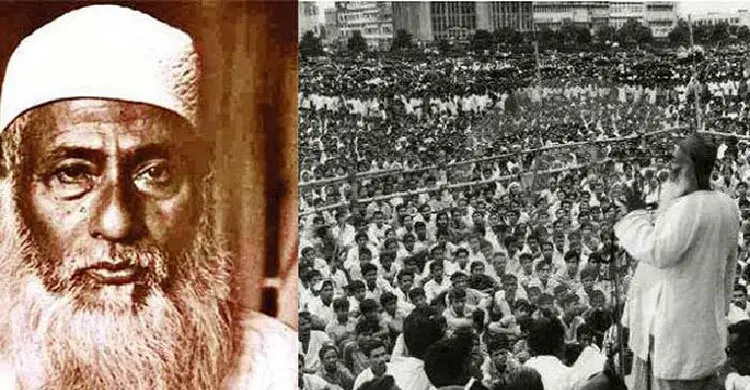
DST News: A seven-day traditional Bhashani Fair has begun at his mausoleum in Santosh, Tangail.
The 50th death anniversary of Maulana Abdul Hamid Khan Bhashani, one of the most influential political leaders in the subcontinent who dedicated his life to fighting exploitation, discrimination and injustice, is being observed on Tuesday.
Various programmes have been organised in Santosh, Tangail, to mark the occasion. His family, political parties, social and cultural organisations, and educational institutions have made arrangements to pay tribute to the legendary leader.
Maulana Bhashani died on November 17, 1976, while receiving treatment at the then PG Hospital in Dhaka. He was later laid to rest in Santosh, Tangail.
A traditional seven-day Bhashani Fair has already begun on the premises of his mausoleum. The fair, held adjacent to Maulana Bhashani Science and Technology University, has attracted devotees, followers and visitors from different parts of the country.
The day’s programmes began in the morning with floral tributes, recitation of Fateha and special prayers at his mausoleum. His family, university authorities, the Bhashani Foundation, political parties and various organisations have arranged discussions and prayer sessions throughout the day. Distinguished personalities from across the country are also expected to visit the mausoleum and participate in the commemorative programmes.
Born on December 12, 1880, in Dhangara village of Sirajganj, Abdul Hamid Khan Bhashani lost his parents at an early age and grew up facing numerous hardships. Alongside his formal education, he studied Islamic teachings and philosophy at the renowned Darul Uloom Deoband in India. He began his career as a teacher in Kagmari, Tangail, but later devoted his life to organising movements for the rights of farmers, workers and ordinary people.
Throughout his political career, Bhashani played a significant role in progressive politics across the subcontinent, particularly in movements against imperialism, domination and exploitation. His lifelong struggle for the rights of the oppressed earned him the title of “Majlum Jananeta”, meaning leader of the oppressed.
While living in Bhashan Char in Assam’s Dhubri district, he gained recognition for leading movements advocating peasant and land rights. His contributions to these struggles earned him the name “Bhashani”.
His political journey was closely associated with the struggle for self-determination and liberation in this region. During British rule, he led resistance against Assam’s Line System and the Bengali Expulsion movement. He also played a significant role in the movement to abolish the zamindari system and establish farmers’ land rights. In 1947, he took an active part in the Sylhet referendum campaign, advocating Sylhet’s inclusion in East Bengal.
Following the creation of Pakistan, Bhashani emerged as a leading voice against discrimination by the ruling authorities. On June 23, 1949, the East Pakistan Awami Muslim League was established under his leadership at Rose Garden in Dhaka, with him becoming its founding president. Later, in 1957, he founded the National Awami Party (NAP) to promote secular and anti-imperialist politics.
He also made significant contributions to the Language Movement of 1952. As one of the key organisers of the All-Party State Language Action Committee, he participated in the movement and was subsequently arrested.
After Bangladesh gained independence, Bhashani continued his political activism, focusing on people’s rights and national interests. On May 16, 1976, at the age of 96, he led the historic Farakka Long March, demanding a fair share of the Ganges water and drawing attention to environmental protection and biodiversity. The march received widespread attention both nationally and internationally.
Rather than pursuing political power or personal positions, Maulana Bhashani remained committed to securing the rights of the marginalised. His uncompromising stance against exploitation, his anti-imperialist politics and his simple lifestyle continue to make him a significant figure in the political history of Bangladesh and the wider subcontinent.