

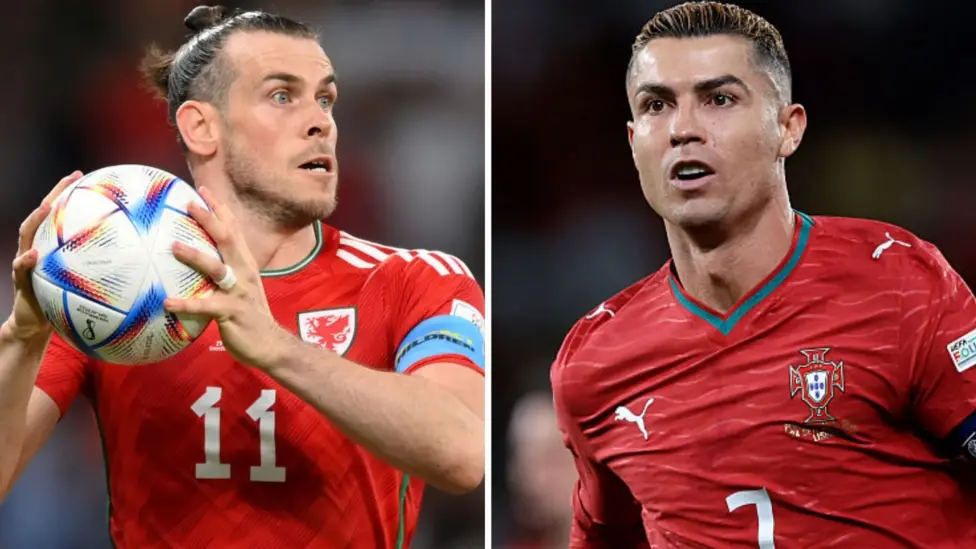
DST News: Portugal are beginning life without Cristiano Ronaldo, while Wales have had nearly four years to adjust to the retirement of their own football icon, Gareth Bale, ahead of Tuesday’s Nations League encounter between the sides.
The two players enjoyed remarkable careers, becoming the leading international goalscorers and most-capped players for their respective countries. Ronaldo also holds the record for the most international goals scored by a male footballer.
Their influence, however, extended far beyond individual statistics. Both became global ambassadors for their countries and inspired generations of supporters.
Ronaldo guided Portugal to their first major international trophy at Euro 2016, defeating Bale’s Wales in the semi-finals before winning the title. The result ended Wales’ memorable run in their first major tournament in 58 years.
The pair also shared five trophy-laden seasons at Real Madrid, winning four and five Champions League titles respectively, alongside multiple La Liga honours and other individual accolades.
Wales captain Ben Davies, who played alongside Bale and faced Ronaldo in what proved to be the Portuguese forward’s final international appearance, acknowledged the significance of losing such an influential figure.
“You’re losing an icon of the national team,” Davies said, adding that Bale’s departure had created opportunities for other players to step forward.
He also noted that Ronaldo’s retirement would be a significant loss for Portugal, but football would eventually move on.
Different departures, different circumstances
Despite their similar legendary status, the circumstances surrounding their international retirements were quite different.
Bale announced his retirement in January 2023 at the age of 33, recognising that his physical abilities were declining and that Wales needed to prepare for the future. Although his departure prompted widespread tributes, he largely avoided the spotlight.
Ronaldo’s departure, by contrast, was more controversial. The 41-year-old’s international career ended earlier this month following a turbulent period with Portugal.
In September, he reportedly left the national team camp after learning that he would not start a Nations League match against Denmark. The incident resulted in a £215 fine and a 30-day suspension.
As a result, Ronaldo did not receive the farewell many had expected, having been unaware that his previous appearance against Wales would be his last international match.
Wales head coach Craig Bellamy paid tribute to Ronaldo’s extraordinary career, describing him as one of football’s greatest figures.
He said Ronaldo had left a lasting mark on the game and expressed gratitude for having had the opportunity to watch and coach against him.
Can Portugal thrive without Ronaldo?
Although Ronaldo’s international career was filled with records and achievements, questions had emerged about his influence during his final years.
His performances at recent major tournaments, including this summer’s World Cup, prompted debate over whether Portugal could perform better without their long-serving captain leading the attack.
However, Portugal’s first match following his retirement, a 4-1 home defeat against Denmark on Saturday, has renewed questions about the team’s ability to cope without him.
Bellamy pointed out the criticism Ronaldo had faced while playing, noting the irony that Portugal struggled immediately after his departure.
Nevertheless, the Welsh coach remains confident that Portugal have enough quality to overcome the transition.
He highlighted the country’s remarkable depth, pointing to previous generations of Portuguese stars such as Luis Figo, Rui Costa and Eusebio.
Portugal’s depth gives them an advantage
The biggest difference between Portugal’s transition after Ronaldo and Wales’ adjustment following Bale’s retirement lies in the quality and depth of their respective squads.
Portugal remain one of the world’s strongest national teams, with elite players across almost every position. Their squad includes numerous Champions League winners, while four Portuguese players were among this year’s Ballon d’Or nominees.
Wales, meanwhile, have considerably fewer resources. Their current squad includes four players from League One and another footballer on loan in the National League.
Although both countries compete in the same Nations League group, their squad strength reflects very different footballing realities.
Bale was part of a wider golden generation, but Wales’ limited resources made his achievements even more remarkable.
Players such as Harry Wilson have taken on greater responsibilities since Bale’s retirement. However, Wilson himself acknowledged earlier this year that nobody could replace Wales’ greatest footballer.
The same could be said of Ronaldo in Portugal, where he enjoys an extraordinary following among supporters.
In terms of squad depth, however, Portugal appear better equipped to move forward without their legendary forward.
The reigning Nations League champions will travel to Cardiff on Tuesday without one of football’s greatest players but with a wealth of talent still available.
Asked whether Ronaldo’s retirement would change Wales’ approach to the match, Bellamy said it would not, emphasising the quality of the Portuguese squad.
He noted that Portugal still have around 15 Champions League winners and insisted the team would remain competitive.
Portugal, he added, had been successful before Ronaldo, enjoyed an extraordinary era with him and would continue to achieve success after his departure.
Source: BBC