

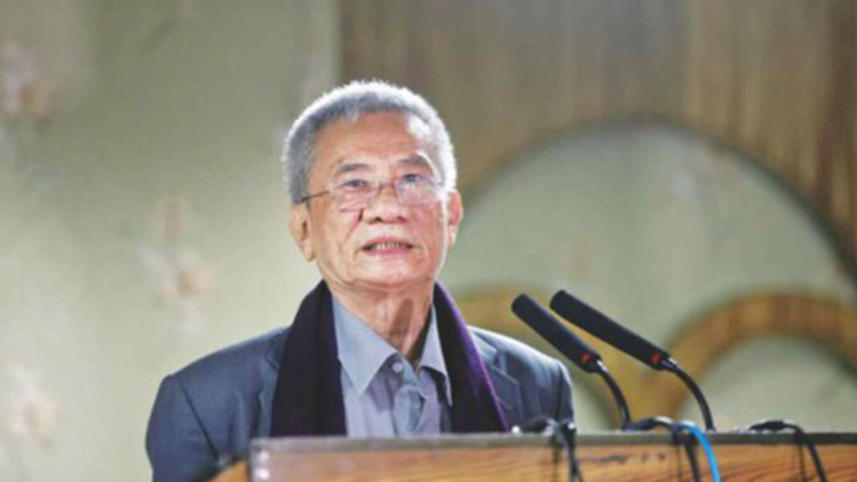
DST News: Indigenous people remain alienated in their own land and deprived of their rights, with no one standing up for them, said Jyotirindra Bodhipriya (Santu) Larma, president of the Bangladesh Indigenous Peoples Forum (BIPF).
Despite taking part in every democratic movement, from the Liberation War to the July uprising, indigenous communities have repeatedly faced neglect and threats to their rights, dignity, land, security and existence in both the hills and the plains, he said.
Larma made the remarks in a written statement read out on his behalf at the opening session of the BIPF’s sixth national conference at the Liberation War Museum auditorium in Dhaka yesterday.
“Many indigenous people took part in the Liberation War with the hope of building a beautiful, dignified life. But the ruling elite shattered that dream while framing the constitution in 1972. They imposed a Bangalee identity on us,” he said.
Larma alleged that indigenous representatives had been excluded from discussions by the Constitution Reform Commission and the National Consensus Commission formed under the interim government following the 2024 uprising.
He said the special committee on constitutional amendments established by the current BNP-led government had also failed to consult indigenous leaders.
Highlighting threats facing indigenous communities in different parts of the country, Larma said betel-leaf gardens in Khasi villages in Sylhet had come under attack, while indigenous people in Madhupur were facing cases filed by the Forest Department. Rakhine communities in Barguna, Patuakhali and Cox’s Bazar were also facing the threat of eviction, he added.
The Santal community, meanwhile, remained concerned over a proposed export processing zone on land belonging to the Sahebganj-Bagda Farm, he said.
Larma further alleged that, rather than implementing the Chittagong Hill Tracts (CHT) Peace Accord, efforts were being made to undermine the rights of the Jumma people.
He called for greater unity in the movement to protect indigenous rights.
BIPF General Secretary Sanjeeb Drong said there was an opportunity to secure constitutional recognition of indigenous people and their rights to self-determination, land, and social and cultural protection.
He said the forum had submitted written proposals to the special committee on constitutional amendments.
Drong also presented a 10-point demand that included a national policy for indigenous people, a separate ministry, a land commission for the plains and a roadmap for implementing the CHT Peace Accord.
Iftekharuzzaman, executive director of Transparency International Bangladesh, attributed violations of indigenous rights to the abuse of power and corruption at state, political, bureaucratic and military levels.
Questioning the army’s role in the CHT, he said that although the force contributed to peacekeeping efforts worldwide, it had failed to establish peace in a region under its direct authority.
He urged people across the country to speak out in support of indigenous rights.
Senior Supreme Court lawyer Subrata Chowdhury also called for political and social unity, saying the struggle for indigenous rights was part of a broader effort to protect the country’s heritage and the rights of its people.
BIPF Vice-President Ajay A Mree chaired the session.
Kazi Sajjad Zahir Chandan, president of the Communist Party of Bangladesh, and Shamsul Huda, executive director of the Association for Land Reform and Development, also addressed the conference.
Source: The Daily Star