

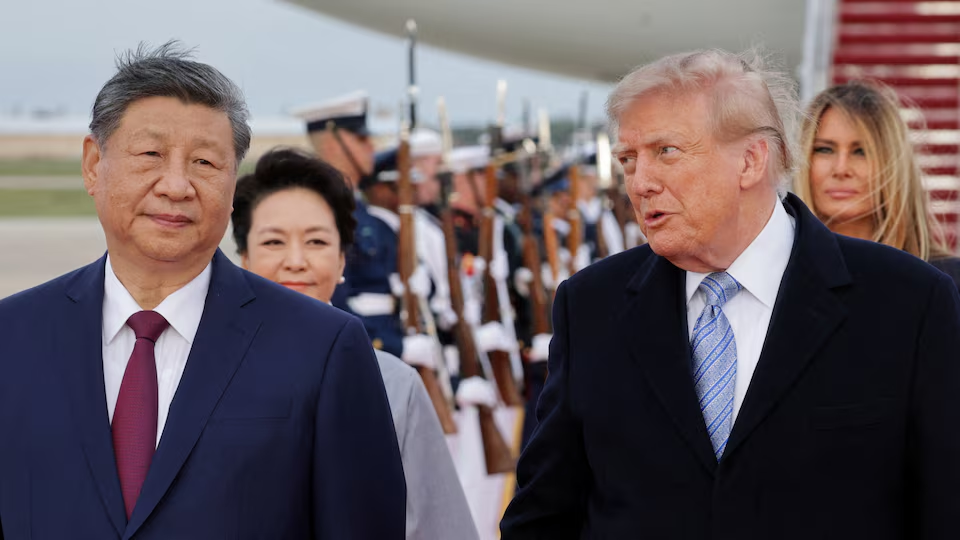
DST News: US President Donald Trump is heading to Asia this week amid mounting political pressure following a major midterm election setback and allegations involving a suspected Chinese spy linked to Nvidia’s chief executive, adding fresh uncertainty to his upcoming meeting with Chinese President Xi Jinping.
Trump will first travel to Manila on Tuesday for meetings with Southeast Asian and other regional leaders before heading to Shenzhen to attend the Asia-Pacific Economic Cooperation (APEC) forum. There, he is scheduled to meet Xi and participate in a trilateral discussion involving Chinese President Xi and Russian President Vladimir Putin.
The visit comes as a fragile trade truce between Washington and Beijing remains in place until early next year. With another round of Trump-Xi discussions expected at the G20 summit in Miami in December, some analysts had initially considered the Shenzhen meeting relatively low-stakes.
However, the Republican Party’s poor performance in this month’s midterm elections and growing criticism of the Trump administration over its handling of intelligence related to Nvidia chief executive Jensen Huang have complicated the diplomatic landscape.
Huang, who has close ties to Trump, has been linked to allegations involving an affair with a woman suspected of spying for China. The controversy has also raised concerns that restricted advanced semiconductors may have been diverted to Chinese customers.
Ruby Osman, a senior China policy adviser at the London-based Tony Blair Institute, said Trump’s weakened political position could make him more willing to take disruptive actions without worrying as much about market reactions or electoral consequences.
Washington has already signalled a tougher approach ahead of the meeting, urging Beijing to fulfil its commitments under the trade agreement reached by Trump and Xi a year ago.
Chinese analysts are particularly concerned that the Nvidia controversy could harden Washington’s position on technology exports to China.
US House Speaker Mike Johnson said last week that bipartisan support was growing in Congress for further restricting China’s access to advanced semiconductors. Democrats are also expected to push the issue more aggressively when they assume control of both chambers of Congress in January.
Beijing has rejected the allegations surrounding the suspected spy, accusing Washington of fabricating the narrative to justify a technological blockade against China.
Zhu Feng, director of the Institute of International Studies at Nanjing University, warned that the controversy could accelerate the separation of the two countries’ artificial intelligence industries, even as Washington and Beijing seek cooperation on managing the technology’s potential risks.
A senior US administration official, speaking anonymously, said Trump was not expected to directly raise the espionage allegations with Xi, adding that the Nvidia controversy should have little impact on the visit.
Trump seeks to build his diplomatic legacy
Rather than opening new disputes with Beijing, Trump may use the visit to pursue initiatives that could strengthen his international legacy, including nuclear arms control agreements involving China and Russia and efforts to arrange another meeting with North Korean leader Kim Jong Un.
Trump reportedly views the unprecedented trilateral meeting with Xi and Putin as a possible opportunity to make progress towards an agreement on nuclear arms control.
However, Chinese analysts consider such an arrangement unlikely because China possesses significantly fewer nuclear warheads than the United States and Russia.
Trump may also seek support from Xi and Putin in arranging a future meeting with Kim, who maintains close relationships with both leaders.
Victor Cha of the US-based Center for Strategic and International Studies said Trump would be focused on building his legacy, with diplomacy involving North Korea remaining a major priority throughout his two presidential terms.
The proposed trilateral meeting has also drawn comparisons, particularly in Russia, with the 1945 Yalta Conference, where the United States, Britain and the Soviet Union negotiated post-war arrangements and spheres of influence.
The Yalta meeting helped shape the international order following World War Two and has since become associated with major powers making decisions that affect smaller countries.
Such comparisons are particularly concerning for Ukraine, which has been fighting Russia for four years. However, the senior US official said Trump was not expected to discuss the Ukraine war during the meeting.
China sees an opportunity amid Trump’s political difficulties
Xi may also attempt to capitalise on Trump’s weakened political position following the Republican Party’s midterm election losses, analysts say.
One of Beijing’s main priorities is preventing Trump from approving a proposed $14 billion arms package for Taiwan, which China considers part of its territory.
Trump has described the weapons package as a negotiating tool in discussions with Beijing and has so far held back approval.
However, with China’s export-driven economy performing strongly, Beijing may benefit simply from extending the current period of relative stability, according to Jonathan Czin, a foreign policy analyst at the Brookings Institution.
Czin, a former CIA official who also served as director for China at the US National Security Council, said Xi wanted Trump to remain reluctant to adopt a more confrontational approach towards China for as long as possible.
He added that Beijing would use the additional time to strengthen its position ahead of future competition with Washington.
Both Czin and Osman noted that Chinese officials would also be mindful that Trump’s successor, expected to take office in two years, could adopt a less accommodating policy towards Beijing.
Trump’s predecessor, Joe Biden, repeatedly angered China through criticism of its human rights record and statements suggesting that the United States would defend Taiwan if Beijing launched an attack.
Several potential Republican successors to Trump, including Secretary of State Marco Rubio, are also viewed as taking a tougher stance towards China.
Both sides have reasons to preserve trade truce
Despite their disagreements, Washington and Beijing are likely to avoid reigniting a trade conflict that previously threatened to destabilise the global economy and financial markets.
Kurt Tong, a former senior US State Department official now working with the Asia Group think tank, said both leaders would be cautious about triggering another major trade dispute.
Although Washington has expressed frustration over China’s implementation of the existing trade agreement, Tong expects the truce to be extended beyond its January 10 expiry date.
Chim Lee, a senior China analyst at the Economist Intelligence Unit, also said both countries had strong incentives to preserve the fragile stability in their relationship despite continuing disagreements.
” They both have quite a lot to lose,” he said.
Source: Reuters