

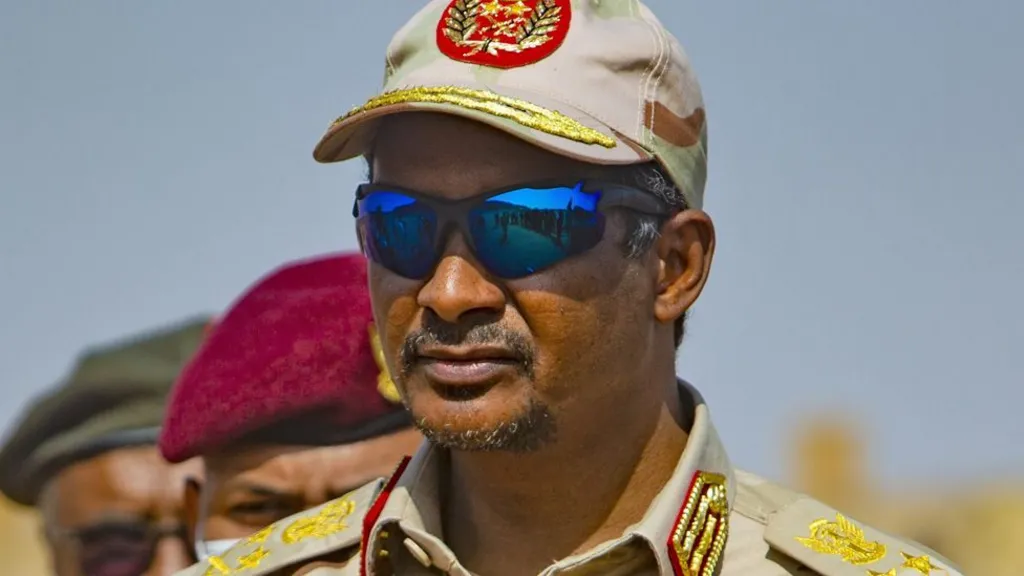
Source: BBC
DST News: Mohamed Hamdan Dagalo, better known as Hemedti, has risen from a humble camel trader to one of Sudan’s most powerful warlords, with his paramilitary Rapid Support Forces (RSF) now controlling nearly half of the country’s territory.
The RSF recently captured el-Fasher, the last major stronghold of the Sudanese army in Darfur — a symbolic victory that cemented Hemedti’s dominance in western Sudan. To his supporters, he is a fearless leader and reformer; to his enemies, he is a ruthless opportunist responsible for years of bloodshed.
Born around 1974 in Darfur’s Mahariya branch of the Rizeigat tribe, Hemedti grew up among camel herders before dropping out of school to trade livestock and gold across the desert routes to Libya and Egypt. In the 2000s, he joined the infamous Janjaweed militia, which carried out brutal attacks against non-Arab communities during the Darfur conflict.
The Janjaweed’s campaign of burning villages, mass killings, and rape led to international condemnation and charges of genocide against Sudan’s former leader Omar al-Bashir. Hemedti, then a mid-level commander, escaped prosecution but used the chaos to expand his power.
After briefly rebelling for unpaid wages, he struck a deal with Bashir, who rewarded him with control of lucrative gold mines in Jebel Amir. His family’s firm, Al-Gunaid, soon became Sudan’s top gold exporter. In 2013, Bashir officially formed the RSF under Hemedti’s command, transforming the Janjaweed into a state-backed paramilitary force.
The RSF gained a reputation for both battlefield success and corruption, securing foreign contracts to police migration routes to Libya — while its members were accused of extortion and human trafficking. Later, Hemedti made private military deals with Saudi Arabia and the UAE, sending RSF fighters to Yemen in exchange for millions of dollars in funding. His close ties with Abu Dhabi and reported cooperation with Russia’s Wagner Group further strengthened his global connections.
In 2019, as Sudanese protesters demanded an end to Bashir’s rule, Hemedti turned on his former patron and joined army chief Abdel Fattah al-Burhan in toppling the regime. For a brief period, he presented himself as a reformist, but soon unleashed a brutal crackdown on pro-democracy demonstrators — leaving hundreds dead.
Tensions between Hemedti and Burhan exploded into open war in April 2023, when the RSF tried to seize the army’s headquarters in Khartoum. The ensuing conflict has devastated Sudan, killing tens of thousands and displacing millions. In Darfur, RSF forces have been accused of carrying out genocidal attacks against the Masalit community.
Investigations suggest that the RSF’s sophisticated drones and weapons arrive via a UAE-built airstrip in Chad — a claim the Emirates denies. Despite widespread international condemnation, Hemedti remains defiant, recently announcing an inquiry into “violations” committed by his men during the siege of el-Fasher.
Today, Hemedti presides over a de facto state in western Sudan, with his own government, army, and vast commercial empire built on gold, war, and foreign backing. Many in Sudan believe he dreams of ruling the entire nation — or at least becoming the shadow ruler behind any future government.
As the conflict grinds on and the world’s attention drifts, Hemedti’s grip tightens — and his belief in his own impunity only grows stronger.


