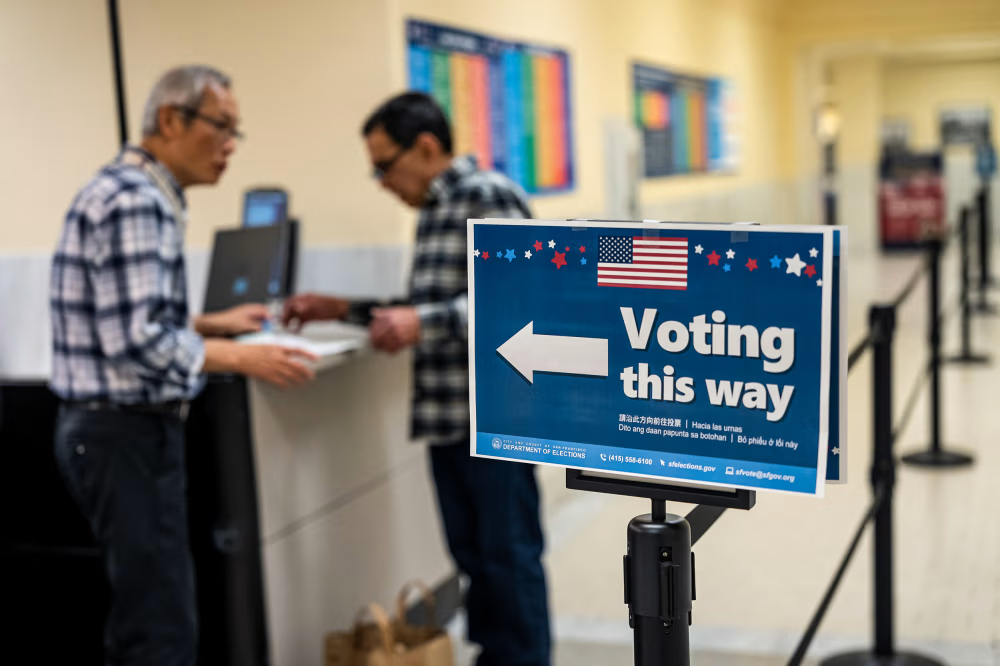
DST News: A federal appeals court on Friday rejected the Trump administration’s latest attempt to require California election officials to set aside ballots associated with more than 20,000 individuals whom the government suspects may be noncitizens.
In a 2-1 decision, a panel of the 9th U.S. Circuit Court of Appeals ruled that the federal government had failed to demonstrate that such an extraordinary measure was legally necessary during an ongoing election.
“The United States has not made the required showing that such extraordinary relief, during an ongoing election, is clearly required by law,” the panel stated.
The majority also agreed with the lower court’s finding that identifying and separating ballots belonging to specific individuals would be impractical and could seriously disrupt the state’s election system.
The ruling included a dissent from Judge Patrick Bumatay, a Trump appointee, who argued that the government’s proposed action was a limited measure that deserved consideration.
“The federal government and the States can work together. California decided long ago that aliens can’t vote in its elections. Today, the federal government merely seeks to safeguard that decision. We should have let them try,” he wrote.
The majority opinion was written by Judge Mark Bennet, another Trump appointee, and Judge Gabriel Sanchez, who was appointed by former President Joe Biden.
Friday’s decision marked the second time within a week that the appeals court had rejected the administration’s request to intervene in the case.
Dispute over alleged noncitizen voters
Earlier this month, the Trump administration filed a lawsuit seeking to compel California election officials to set aside more than 20,000 ballots that it claimed might have been submitted by noncitizens.
However, on Wednesday, U.S. District Judge David Carter rejected the request, ruling that it violated longstanding constitutional principles that give states authority over their election processes.
The judge warned that granting the administration’s last-minute request could allow either political party to disrupt elections for its own political purposes.
Carter also questioned the reliability of the government’s methodology for identifying the alleged noncitizen voters. He noted that the Department of Homeland Security had previously estimated in July that nearly 200,000 noncitizens were registered to vote in California.
“Given the vagueness of Plaintiff’s descriptions of its procedures and the unreliability of its similar claims in other states, the Court cannot conclude that Plaintiff’s process is credible,” Carter wrote.
The judge also highlighted the administration’s earlier claims in Nevada. Federal officials initially identified 15,903 registered voters as potential noncitizens. The figure was later reduced to 6,218 and subsequently to 185 following a manual review.
Nevada officials later confirmed that all 185 individuals were U.S. citizens, according to the judge.
In its previous decision, the appeals court had also questioned the administration’s claim that emergency intervention was necessary. The judges noted that the urgency was, at least partly, created by the government’s own delay in bringing the case so close to Election Day.
The Justice Department did not immediately respond to requests for comment on Friday’s ruling or whether it intended to seek emergency intervention from the Supreme Court.
Voting rights advocates welcome decision
Kristen Clarke, general counsel of the NAACP, which participated in defending the case, welcomed the appeals court’s decision.
“The Department of Justice sought to throw out the voices of more than 20,000 Californians without credible evidence and outside the established safeguards that protect voters’ rights,” Clarke said in a statement.
She added that the ruling reinforced the importance of conducting elections according to evidence, legal standards and constitutional protections.
“Today’s decision sends a clear message: our elections must be governed by facts, law, and constitutional principles, not political interference or voter suppression,” the statement said.
Source: NBC NEWS