

Source: BBC
DST News: Seventy years ago, the British Empire staked its final territorial claim—a remote, windswept rock in the North Atlantic known as Rockall, lying some 260 miles (420 km) west of Scotland’s Outer Hebrides. Though little more than a jagged granite outcrop, its strategic position during the Cold War transformed it from a geological curiosity into a symbol of sovereignty and security.
A Desolate Rock with Strategic Value
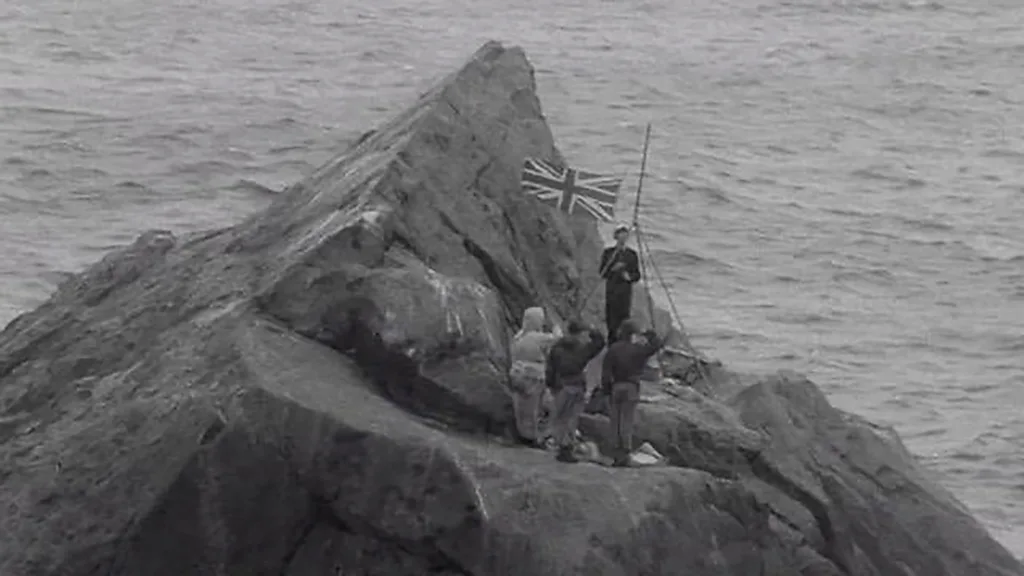
In 1955, Queen Elizabeth II authorised the Royal Navy to annex Rockall to prevent Soviet spies from exploiting it as a listening post. On 14 September, the HMS Vidal arrived at the site. Three days later, after high winds eased, Commander Richard Connell and three Royal Marines, accompanied by naturalist James Fisher, were winched onto the rock.
There, they planted the Union Jack and claimed Rockall for Britain. “I had an instruction from Her Majesty to annex the island in her name,” Connell told the BBC afterwards. “We sent a signal to the Admiralty saying, ‘Operation Rockall successfully completed.’ I was never so glad to send any message in my life.”
Fisher, tasked with geological sampling, later reported that Rockall was a remnant of an ancient volcano. The samples revealed a previously unknown mineral—bazirite—unique to the site.
Cold War Fears and Maritime Ambitions
Although first charted in 1831, Rockall gained new importance in the 1950s, when the UK established a guided-missile testing site on South Uist, just 230 miles away. NATO feared that “hostile agents” might occupy the rock to monitor missile tests, prompting the annexation.
Over time, however, the island’s value shifted from defence to economic opportunity. The surrounding seas teemed with fish and hinted at potential oil and gas reserves. To reinforce its claim, Britain passed the Island of Rockall Act (1972), incorporating it into Scotland’s Western Isles.
Yet Ireland, Iceland, and Denmark (on behalf of the Faroe Islands) all rejected the British claim. The 1982 UN Convention on the Law of the Sea later undermined the UK’s position, declaring that uninhabitable rocks could not be used to claim surrounding waters.
Adventurers, Activists, and a Political Symbol
Rockall has since lured a mix of patriots, environmentalists, and thrill-seekers. In 1985, ex-SAS soldier Tom McClean spent 40 days on the islet to prove it could sustain human life, becoming the first known person to live there. “No one cared when we first claimed it,” he said, “but when oil became valuable, everyone wanted Rockall.”
In 1997, Greenpeace activists occupied the rock for 42 days, declaring it the “capital” of a fictional nation called the Global State of Waveland to protest against offshore mining licences. Their stunt coincided with the UK’s formal acceptance that Rockall was legally just a “rock,” ending its exclusive claim to the surrounding 200-mile zone.
A Rock Still Fought Over
Despite losing its legal power to secure marine resources, Rockall’s surrounding waters remain contested—particularly rich fishing grounds coveted by Britain, Ireland, and other North Atlantic nations. The barren outcrop continues to fascinate explorers and adventurers.
In 2014, Nick Hancock set a world record by surviving 45 days on Rockall. Others have not been as fortunate. In 2023, Army veteran Cam Cameron had to be rescued mid-expedition after storms destroyed his equipment. “There’s nothing as terrifying as being on that rock—300 miles from people, 200 miles from the nearest land,” he told the BBC.
Even today, what Lord Kennet once described as “the most desolate, despairing place in the world” endures as both a relic of Britain’s imperial past and a symbol of its ongoing struggle to hold its place in the turbulent North Atlantic.


