

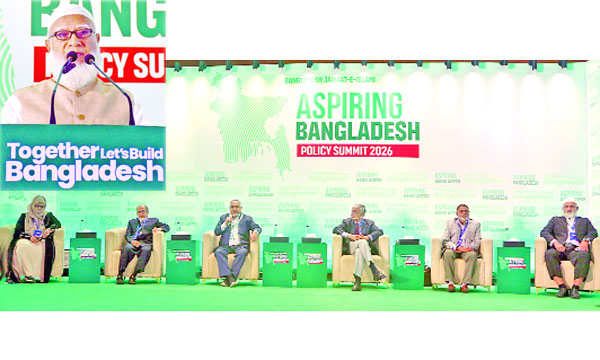
DST News: Among the key programs announced at the Policy Summit in the areas of economy and anti-corruption are: adopting a zero-tolerance policy against corruption; gradually reducing tax and VAT to bring tax down to 19 percent and VAT to 10 percent; formulating business-friendly policies and introducing an easy licensing system; not increasing gas, electricity, and water charges for the next three years; reopening closed factories under public–private partnership with 10 percent ownership allocated to workers; and providing interest-free loans to small and medium farmers.
At the ‘Policy Summit 2026’ of Bangladesh Jamaat-e-Islami, the party announced an outline for building a new Bangladesh. The summit, held at Hotel InterContinental in the capital, announced 31 policy points and programs through various panel discussions aimed at building a new Bangladesh.
Ambassadors from home and abroad, top leaders of political parties, academics, journalists, intellectuals, and professionals were present at the summit. Participants included representatives from the United States, the United Kingdom, China, India, Pakistan, Kosovo, Turkey, Malaysia, Sri Lanka, Brunei, Australia, Italy, Denmark, Singapore, the Philippines, Indonesia, the Maldives, Iran, Canada, Palestine, Afghanistan, Libya, Algeria, the European Union, France, Germany, Japan, Norway, Sweden, the Netherlands, South Korea, Bhutan, Thailand, Switzerland, Spain, Brazil, the United Nations, UNDP, and IRI. Jamaat-e-Islami Ameer Dr. Shafiqur Rahman delivered the inaugural address.
The key economic and anti-corruption programs announced at the summit include: adopting zero tolerance against corruption; gradually reducing tax and VAT to 19 percent and 10 percent respectively; introducing business-friendly policies and simplified licensing; keeping gas, electricity, and water tariffs unchanged for the next three years; reopening closed factories through public–private partnerships with 10 percent ownership for workers; and providing interest-free loans to small and medium farmers.
Education-related programs include: providing interest-free loans of BDT 10,000 per month for up to two years to five lakh graduates until they secure jobs; offering interest-free education loans of BDT 10,000 per month to one lakh students based on merit and need; granting interest-free education loans each year to 100 students to study at the world’s top universities; merging Eden College, Begum Badrunnesa College, and Home Economics College to establish the world’s largest women’s university; upgrading large colleges under the National University into universities; and ensuring all recruitment is merit-based.
Health sector programs include: free healthcare for senior citizens above 60 and children under five; establishing 64 specialised hospitals in all 64 districts; and ensuring maternal and child health and nutrition from pregnancy until a child reaches two years of age under the ‘First Thousand Days Program.’
Youth power and employment programs include: establishing a new ministry for skilled manpower development and job placement; providing market-based skills training to 10 million youths over five years; setting up ‘Youth Tech Labs’ in every upazila and ‘District Job Youth Banks’ in every district; creating five lakh entrepreneurs and 1.5 million freelancers from among women, youth, and marginalised communities; and developing suitable skill programs for low-educated youth.
ICT and Vision 2040 programs include: announcing ‘Vision 2040’ for ICT sector development; creating 2 million ICT jobs by 2030; establishing a national payment gateway for freelancing and digital exports; setting a target of USD 50 billion in ICT export earnings; saving USD 15 billion in government expenditure; and transforming the economy from labour-dependent to knowledge-based.
On remittances, the programs include: increasing remittance income two to three times within five to seven years through skilled manpower; and bringing back expatriate professionals, researchers, and teachers as ‘intellectual remittance’ to contribute at home.
Goal: Democratic Transition, Economic Stability, and Human Dignity
Addressing the conference, Dr. Shafiqur Rahman said that after a long period of authoritarian rule, Bangladesh is now undergoing a sensitive democratic transition. In this context, the upcoming election is not merely a political event but a crucial moment to determine a new direction of governance for a country of over 180 million people.
He noted that over the past 17 years, failures in governance and authoritarian practices have hollowed out state institutions from within and narrowed the democratic space.
Referring to the mass uprising of 2024, he said that ordinary people, especially the youth, took to the streets to reclaim their rights, voices, and future. After passing through a “dark period” of fascist rule, Bangladesh now stands at a critical juncture, where major challenges to national reconstruction still remain.
Dr. Rahman said that the country’s biggest challenge today is not survival, but stability. Although the economy has expanded, the quality of employment has declined. Most jobs remain informal, insecure, and low-paid.
Calling for an honest confrontation of these realities, he said that economic growth alone cannot be the sole measure of success. Economic success should enable people to plan their lives with confidence, run families with dignity, and participate meaningfully in society.
He said that millions of expatriate workers abroad demonstrate deep patriotism through their labor and sacrifices. Their remittances not only support families but also stabilize the economy and connect Bangladesh to the global labor market. However, their contribution is not limited to money alone; they are eager to play a greater role by bringing back skills, experience, and global exposure.
He noted that Bangladeshi professionals working across the world—academics, doctors, engineers, entrepreneurs—are leading international institutions and universities. Many of them remain deeply connected to the country and are ready to help build institutions, mentor the next generation, and support reforms.
Dr. Rahman said Bangladesh has fertile land, extensive rivers, a long coastline, and a strategic location linking South and Southeast Asia. These natural and geographic assets create opportunities for sustainable growth, regional connectivity, and diversified development. The question is no longer whether Bangladesh has potential, but whether existing institutions, policies, and political decisions can transform that potential into prosperity.
Highlighting the need for a shift in economic thinking, he said employment must be treated as a state priority, not merely a by-product of investment. Informal labour must gradually be brought under formal structures; workers’ rights must be effectively ensured; education must be linked to real opportunities; and social welfare must be viewed not as charity but as enabling social infrastructure. At the heart of this transformation lies good governance.
He said when the state delivers services fairly and predictably, citizens’ trust, lawfulness, and initiative increase. Zero tolerance against corruption was reaffirmed at the conference.
According to Dr. Rahman, Bangladesh’s future depends on partnerships between the state and citizens, the public and private sectors, and Bangladesh and the international community. He emphasized engagement, cooperation, and shared responsibility.
He said that a stable and progressive Bangladesh is not only in the interest of its people, but also of the entire region and the world. Bangladesh stands once again at a historic crossroads. A prosperous Bangladesh must be built on justice (insaf), dignity, and shared prosperity. With the strength of the people, the commitment of expatriates, women’s leadership, youth enthusiasm, and support from international friends, Bangladesh has the capacity to become a just, equitable, and prosperous state.
Emphasizing the critical role of women in Bangladesh’s future, Dr. Rahman said that despite structural barriers, women are already playing active roles in education, healthcare, entrepreneurship, local leadership, and social innovation. Increasing women’s participation is not only a matter of justice; it is an economic necessity. No country can achieve sustainable prosperity without fully including half its population.
Dr. Shafiqur Rahman said that in the past, the country was plundered and left as a skeleton. “We have received a skeleton, and we will move forward with it. We will turn this skeleton into a living Bangladesh.”
He said that if Bangladesh does not do well, no one will do well. Compared to how other countries have progressed since his childhood, Bangladesh has fallen behind. “Can we leave our next generation like this?” he asked, calling on the nation to become “young again” and fight once more.
Addressing the youth, he said their task is not finished; it has only begun. “You have driven away a dictator, but the authoritarian mindset has not yet disappeared from the country. The struggle will continue until it is eradicated. We will stand with you and beside you.”
He said two targets must be fixed. First, reform must begin at the primary education level, and purely theoretical education irrelevant to the country must be discarded. Second, social justice must be ensured—with no compromise. Justice must be established even at the cost of personal sacrifice. There must be fair and equal justice for all, with no discrimination between powerful and powerless. Injustice, bribery, and corruption cannot exist in society.
Stating that he would not take any state privileges, the Ameer said they have declared that even if given the opportunity to serve, they would not accept state benefits except what is absolutely necessary. “We have not taken politics as a profession; we have taken it as a duty. We do not do politics to amass wealth. Our politics will be successful only when the tears in people’s eyes stop and a faint smile appears on their lips.”
Among other Jamaat leaders present were Naib-e-Ameer Dr. Syed Abdullah Mohammad Taher and Maulana A. N. M. Shamsul Islam; Secretary General Mia Golam Parwar; Assistant Secretaries General Maulana A. T. M. Ma’sum, Maulana Rafiqul Islam Khan, Dr. Hamidur Rahman Azad, Maulana Abdul Halim, and Advocate Ehsanul Mahbub Jubayer; Central Executive Committee members Saiful Alam Khan Milon and Mobarak Hossain.
Leaders from other parties present included Khilafat Andolon Naib-e-Ameer Maulana Mujibur Rahman Hamidi, another faction’s Secretary General Mufti Fakhrul Islam, NCP Member Secretary Akhtar Hossain, northern region chief organiser Sarjis Alam, and Joint Member Secretary Zainal Abedin Shishir, among others.
Also present were CPD Distinguished Fellow and founding Executive Director Dr. Debapriya Bhattacharya; senior Supreme Court lawyer Shahdeen Malik; former MP Major (Retd.) Akhtaruzzaman; Ibn Sina Trust member (administration) Professor Dr. A. K. M. Sadrul Islam; The Daily Star Editor Mahfuz Anam; veteran editor Abul Asad; Naya Diganta Editor Salahuddin Muhammad Babar; Executive Editor Masumor Rahman Khalili; The New Nation Editor Mokarram Hossain; Prothom Alo Executive Editor Sajjad Sharif; DUJ President and Manabkantha Editor Mohammad Shahidul Islam; Dhaka Mail Executive Editor Harun Jamil; DUJ General Secretary Khurshid Alam, and other media leaders.


