

DST News: Thousands of Mexicans marched in cities across the country on Saturday to denounce rising crime, entrenched corruption and widespread impunity. Although the protest was initially spearheaded by Generation Z activists, the crowds ultimately drew strong participation from older supporters aligned with opposition parties.
Demonstrators representing a range of age groups filled public squares, with many wearing straw hats in honour of slain Michoacan Mayor Carlos Manzo, a symbol of his anti-cartel political movement.
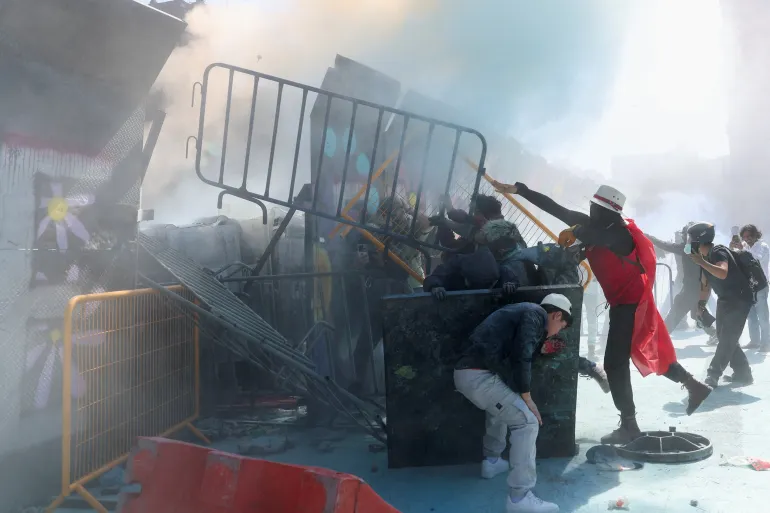
In Mexico City, tensions escalated when a small group of masked protesters dismantled metal barriers surrounding the National Palace, the residence of President Claudia Sheinbaum. The confrontation quickly intensified as riot police responded with tear gas, according to local media reports.
Mexico City’s public safety chief, Pablo Vázquez, said 100 police officers were injured in the clashes, including 40 who were taken to hospital. He added that 20 civilians were also hurt and that authorities made 20 arrests, with another 20 people detained on administrative charges.
The newspaper El Universal reported that security forces hurled stones alongside tear gas as demonstrators pushed into the restricted area. Young protesters were beaten and later treated by volunteer medics marching with the crowd and by emergency personnel on site, the outlet said. Officers eventually dispersed the remaining demonstrators after chasing them through the Zócalo, it added.
The protests took shape amid an online debate earlier in the week. Some Gen Z influencers distanced themselves from the event, while prominent public figures—including former President Vicente Fox and billionaire Ricardo Salinas Pliego—publicly expressed their support.
President Sheinbaum accused right-wing groups of attempting to co-opt the youth-led movement and of manipulating social media engagement through bots to inflate expected turnout.
Youth-driven protests have surged globally this year, particularly in Asia and Africa, where frustration over inequality, corruption and shrinking democratic space has fuelled mass mobilisations. In Nepal, Gen Z demonstrations in September—triggered by a social media ban—eventually led to the resignation of Prime Minister KP Sharma Oli. In Madagascar, anger over persistent power and water shortages spiralled into nationwide protests that forced the dissolution of the government and the departure of President Andry Rajoelina.
In Mexico, many younger citizens say the latest marches reflect deep-seated anger at persistent violence and a justice system that rarely delivers accountability.
“We need more security,” said 29-year-old consultant Andrés Massa, who carried the pirate-skull flag that has become a hallmark of Gen Z protest movements worldwide.
Others joined over more personal concerns. Claudia Cruz, a 43-year-old physician, said she marched for stronger public healthcare funding and better protection for medical workers, who she said face the same dangers as other citizens.
“You can be killed and nothing happens,” she said.
Despite maintaining approval ratings above 70 percent in her first year in office, Sheinbaum has faced intense scrutiny over her security strategy, particularly after a series of high-profile killings—including that of Mayor Manzo, who was shot dead on November 1 amid his campaign against drug-trafficking groups.
His supporters rallied in several Michoacan towns and many travelled to the capital to join Saturday’s march.
“The state is dying,” said 65-year-old real estate agent Rosa María Ávila from Pátzcuaro.
“He was murdered because he had the courage to send officers into the mountains to confront criminals,” she said.
Source: Aljazeera
If you need a headline, shortened news brief, or SEO-optimized version, feel free to ask.


