

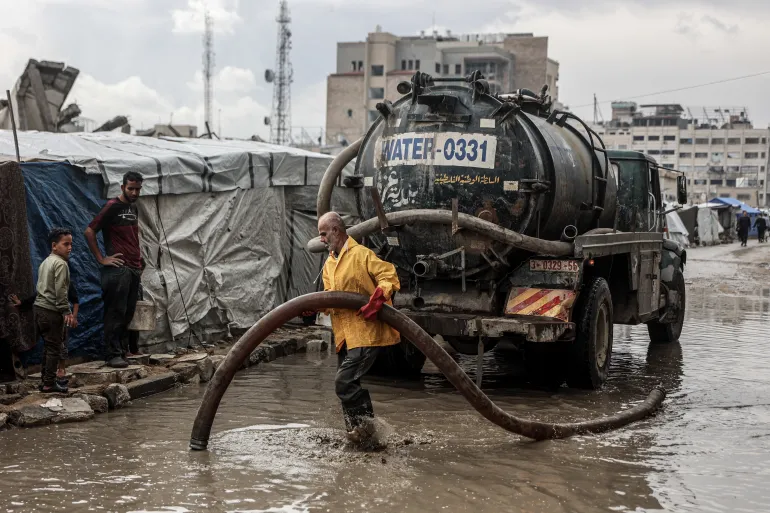
DST News: Biting cold and pounding rain are compounding the misery of displaced Palestinians in Gaza, where Israel continues to block the entry of tents and vital shelter materials, leaving hundreds of thousands exposed to winter weather.
In Gaza City, residents spent Saturday digging makeshift trenches around fragile tents in a desperate attempt to stop rainwater from seeping in. Others sought refuge inside the ruins of bombed-out buildings, despite the danger of collapse.
One displaced mother of two, speaking from Gaza City, said she had been in tears all morning after waking to find her tent flooded overnight. Several members of her family, including her husband, were killed during Israel’s war on the enclave, which began in October 2023.
“I just need a proper tent, a mattress, a blanket. My children don’t even have warm clothes,” she said, adding that she had no one left to turn to for help.
Aid organisations have repeatedly warned that Gaza’s makeshift settlements are nowhere near prepared for harsh winter conditions. Many families have been uprooted more than once during Israel’s two-year bombardment, which the United Nations says has damaged or destroyed about 198,000 buildings.
Despite a ceasefire with Hamas that took effect on October 10, Israel has maintained tight restrictions on humanitarian shipments. Relief agencies say roughly 260,000 Palestinian families—nearly 1.5 million people—are at risk as temperatures drop.
The UN agency for Palestinian refugees, UNRWA, says it has enough shelter supplies for up to 1.3 million people but has been unable to deliver them because of Israeli limitations.
“It’s cold and wet in Gaza,” UNRWA Commissioner-General Philippe Lazzarini wrote online, warning that the absence of proper shelter was worsening an already catastrophic displacement crisis. “Fragile tents flood quickly, soaking whatever belongings people have left. This is misery on top of misery.”
Reporting from the central town of az-Zuwayda, Al Jazeera’s Hind Khoudary noted that many residents have nowhere else to go. With neighbourhoods flattened and shelters overflowing, families remain in waterlogged tents, unable to afford winter clothing or shoes for their children.
On Saturday evening, sources in southern Gaza said Israeli forces fired flares over areas southeast of Khan Younis—signals typically used to illuminate targets ahead of possible attacks. Earlier in the day, air raids struck locations near Khan Younis and northern Gaza City.
“Even though guns have largely fallen silent, the sound of Israeli air strikes continues behind the yellow line,” Al Jazeera’s Ibrahim al-Khalili reported, referring to the boundary set under the ceasefire’s first phase. He said the intensified situation was especially frightening for families living close to that line, including his own.
No casualties were immediately reported from the latest strikes.
According to Gaza’s Health Ministry, 260 Palestinians have been killed and 632 wounded since the ceasefire began. The overall death toll from Israel’s war has risen to at least 69,182, with another 170,703 injured.
Source: Aljazeera
If you’d like, I can shorten this, make it more formal, rewrite for broadcast, or prepare a headline package.


