

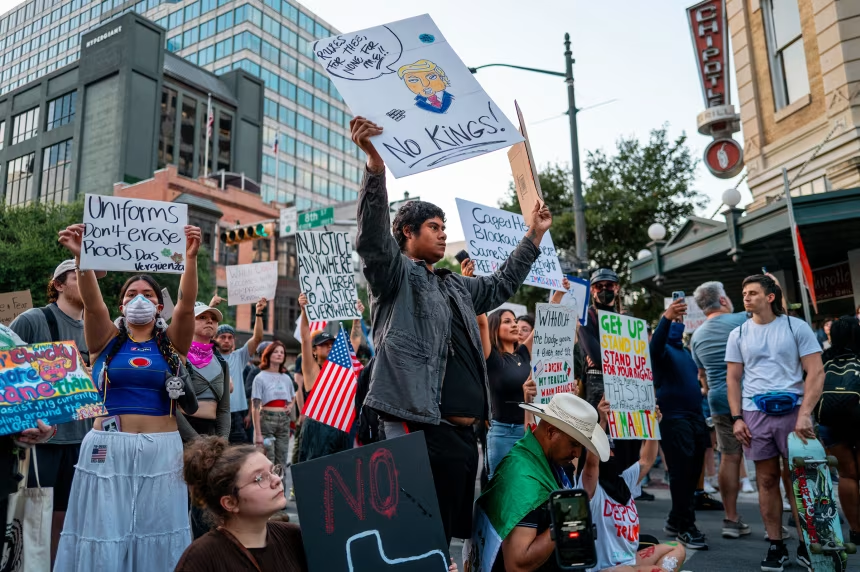
CNN Photo: Protesters gathered in Austin, Texas for a No Kings rally in June.
Source: CNN
Dhaka Straits Times News: In June, demonstrators gathered in Austin, Texas, for a “No Kings” rally. As President Donald Trump arrived in Washington, D.C., for his military parade—marked by a 21-gun salute and a crowd singing “Happy Birthday”—an estimated five million people across the United States took to the streets to voice opposition to his administration. Now, with the government still partially shut down and Trump pushing to send National Guard troops into U.S. cities, organizers say millions more are preparing to mobilize again.
More than 2,500 rallies are planned nationwide on Saturday—roughly 450 more than in June—spanning all 50 states. This second wave of “No Kings” demonstrations seeks to reject what participants describe as the president’s increasingly “authoritarian” use of power.
Some Republican leaders have condemned the protests, calling them unpatriotic. House Speaker Mike Johnson, without providing evidence, claimed that Saturday’s rallies were partly responsible for prolonging the government shutdown.
When the first round of “No Kings” protests erupted earlier this year, Trump had already spent the first five months of his second term issuing a flood of executive orders. His directives targeted birthright citizenship, protections for transgender Americans, student demonstrators, and federal diversity and inclusion programs, among other areas.
Tensions escalated most dramatically in California, where immigration raids in Los Angeles prompted massive demonstrations. Trump’s decision to federalize the California National Guard—despite Governor Gavin Newsom’s objections—was widely criticized by experts as an alarming and unprecedented extension of presidential authority.
Organizers say the administration has only “intensified” its approach since then.
Under growing pressure to meet arrest targets, ICE agents have continued widespread immigration raids, often encountering fierce resistance from local communities. Trump has also urged the Justice Department to pursue charges against his political adversaries, including former FBI Director James Comey and New York Attorney General Letitia James.
The administration has clashed with major media outlets as well—filing a defamation lawsuit against The New York Times and temporarily forcing “Jimmy Kimmel Live!” off the air before its eventual return.
In addition, the White House has expanded efforts to send federal forces into cities led by Democrats, including Washington, D.C., Memphis, Chicago, and Portland.
On October 6, in Portland, police and federal agents arrested demonstrators outside a U.S. Immigration and Customs Enforcement facility during one of several flashpoints between protesters and law enforcement.
Local and state officials continue to resist federal troop deployments, with several legal challenges still pending in court.
Meanwhile, some Republican lawmakers have branded the forthcoming protests as “Hate America” gatherings. Senator Roger Marshall accused “professional agitators” of orchestrating the events, while Speaker Johnson claimed—again without proof—that attendees would include “pro-Hamas” and “Antifa” activists.
Despite such claims, protest organizers maintain that Saturday’s demonstrations will remain peaceful and deliberately contrast what they describe as the administration’s increasing displays of military and political force.


