

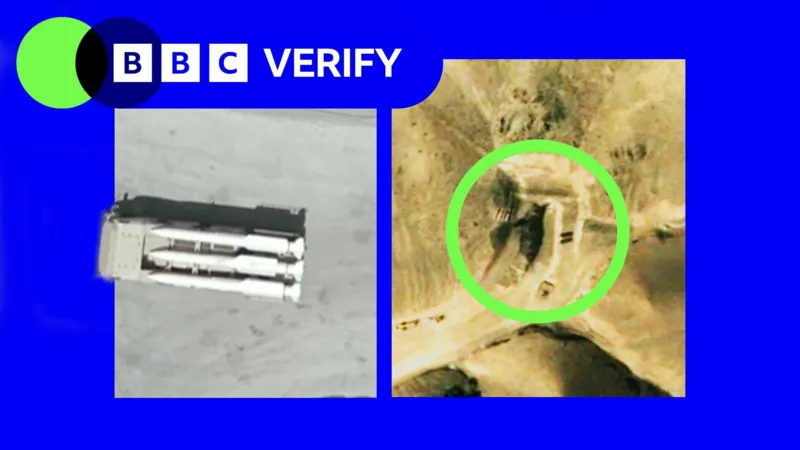
DST News: Iran appears to be carrying out extensive construction near at least two major missile facilities while repairing military bases damaged by months of US and Israeli air strikes, according to an analysis of satellite imagery.
Images captured in November show evidence of excavation work and new buildings at the Garmdareh military base in Karaj, near Tehran, and the Shahroud base in northern Iran. Analysts from British intelligence firm MAIAR reviewed the images and shared their findings with BBC Verify.
At least 12 other military installations, including missile complexes and air bases, also appear to be undergoing repairs. At the Kermanshah missile base in western Iran, near the Iraqi border, new roofs have been installed on damaged buildings. Meanwhile, debris and damaged structures have been cleared from the Parchin military complex east of Tehran, which has been repeatedly targeted in air strikes.
Jim Lamson, a former CIA analyst specialising in Iran, said the excavation work near Shahroud could be linked to missile production. Given that the nearby air base has been attacked several times in recent years, he suggested that Iran’s Islamic Revolutionary Guards Corps (IRGC) may be attempting to relocate production facilities underground.
A MAIAR analyst said Iran has demonstrated a “pattern of moving infrastructure underground to protect them from further strikes”. Mark Mellett, a defence analyst and former head of the Irish military, noted that underground facilities also make it more difficult for foreign observers to determine the scale and operational condition of military installations.
Speculation has increased in recent weeks that the US could launch fresh attacks on Iran following this week’s midterm elections. However, Vice-President JD Vance said on Wednesday that public opposition to the war may have contributed to the Republicans’ poor electoral performance, potentially costing the party control of the Senate for the next six years.
Across several military installations, Iranian forces appear to be concentrating on relatively small-scale repairs to facilities heavily damaged since the beginning of the US-Israeli military campaign.
Analysts also believe substantial reconstruction work has taken place at the Taleghan 2 facility within the Parchin military complex. Satellite images suggest that damaged buildings have been demolished and an underground bunker affected by previous attacks has been repaired and reinforced with concrete.
Significant excavation activity is also visible at Karaj and Shahroud. Images from Karaj show several vehicles at the site, alongside apparent improvements to a nearby airbase.
Sam Lair, a research analyst at the Foreign Policy Research Institute (FPRI), which has closely monitored developments at Iranian military facilities, said the Karaj images appear to show the construction of a new entrance to an underground facility.
An analysis by Janes, a defence intelligence organisation, also points to a new facility under construction at Karaj. The development reportedly includes tunnel entrances and structures that could indicate an expansion of nearby missile facilities that were previously damaged or destroyed. However, the site could also be intended for storage or other purposes.
Janes analyst Sean O’Connor said the construction was unlikely to be an attempt to mislead foreign intelligence agencies, arguing that such an operation would be expensive and offer little benefit.
The developments come amid repeated statements from the White House that US-Israeli military operations have severely weakened Iran’s armed forces. US President Donald Trump previously described the Iranian military as a “complete and total mess”.
A Pentagon spokesperson had earlier claimed that US strikes destroyed up to 90% of Iran’s drone, ballistic missile and naval industrial capabilities, significantly reducing the country’s ability to launch missile and drone attacks.
Iran, however, maintains that it still possesses substantial missile stockpiles. Footage broadcast on Iranian state television this week purportedly showed dozens of missiles positioned at the entrance of an underground facility in southern Iran. Similar footage aired in August appeared to show Khordad surface-to-air missiles emerging from a tunnel near the southern port city of Bandar Abbas.
A MAIAR analyst also identified fresh construction and excavation work outside tunnel entrances near the city of Qom, close to the Fordow underground uranium enrichment facility. The nuclear site has been targeted in multiple US and Israeli air strikes.
Mark Cancian, a military analyst with the International Security Program at the Center for Strategic and International Studies (CSIS), said the increased activity around military facilities suggests Tehran is preparing for the possibility of further attacks by Washington and Tel Aviv.
“The purpose is to better defend itself against future attacks,” he said, adding that the developments also suggest Iran is prioritising the restoration of its military capabilities over economic recovery.
Source: BBC