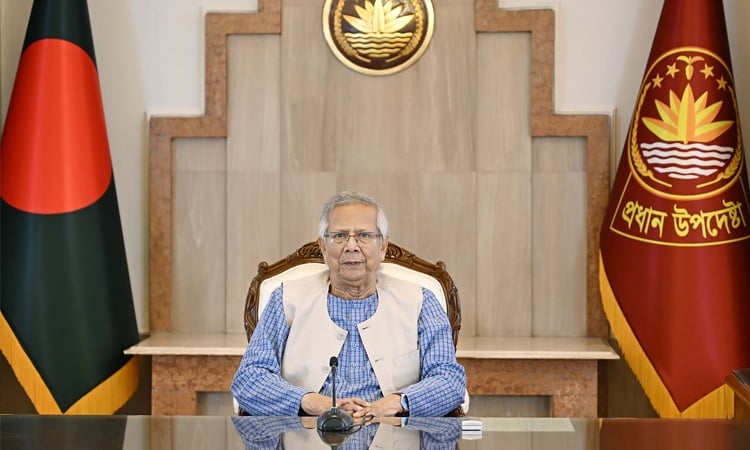
DST News: Chief Adviser Professor Dr Muhammad Yunus has announced that Bangladesh will hold a national referendum on the July National Charter 2025 and the upcoming general election on the same day in the first half of February next year.
In a televised address to the nation on Thursday afternoon, following a meeting of the Council of Advisers at his office, Professor Yunus said, “After reviewing all relevant factors, the government has decided that both the referendum and the parliamentary polls will be conducted on the same day.”
The Council of Advisers, he added, has approved the July National Charter (Constitutional Reform) Implementation Order 2025, marking what he called a “historic step” toward implementing the reform pledges jointly signed by the country’s major political parties. The announcement was broadcast live on BTV, BTV News, and Bangladesh Betar.
Referendum and Election to Be Held Jointly
Professor Yunus said that holding the referendum alongside the national polls would make the process more efficient and cost-effective, without affecting the reform objectives. He noted that necessary laws would be enacted in due course to facilitate the referendum.
The Chief Adviser explained that the implementation order includes provisions for the referendum and the eventual formation of a Constitutional Reform Council, which will oversee the next phase of constitutional changes. “In line with the July Charter, we have finalized the referendum ballot question to be placed before voters,” he stated.
The ballot will ask: “Do you agree to the July National Charter (Constitutional Reform) Implementation Order, 2025, and the following constitutional reform proposals enshrined in the July National Charter?”
Four Key Reform Proposals
The referendum will cover four major reform issues:
A. The formation of a caretaker government, Election Commission, and other constitutional bodies during election time according to the July Charter’s guidelines.
B. Establishment of a bicameral parliament, where a 100-member Upper House will be formed based on proportional representation of votes received by political parties. Any constitutional amendment would require a majority vote in this Upper House.
C. The winning party in the next election will be legally bound to implement the 30 reform proposals agreed upon in the July Charter — including greater women’s representation in parliament, appointment of opposition leaders as deputy speakers and committee chairpersons, limiting the prime minister’s tenure, expanding presidential powers, strengthening judicial independence, and empowering local governments.
D. All other reform commitments in the Charter will be implemented as agreed by political parties.
On the day of the referendum, citizens will cast a single ‘Yes’ or ‘No’ vote covering all four points. If the majority supports the reform, a Constitutional Reform Council will be formed with representatives elected in the new parliament.
The council will have 180 working days to finalize amendments to the constitution, after which the Upper House will be created within 30 working days, its term lasting until the dissolution of the lower house.
The Council of Advisers has also approved a move to incorporate the July Charter into the national constitution, reaffirming the government’s commitment to democratic reform.
A Milestone in Political Consensus
Professor Yunus expressed gratitude to all political parties and members of the National Consensus Commission for their “relentless efforts” to reach a common ground. “The political parties debated and negotiated with great patience and mutual respect. Despite differing views, they worked toward consensus — a rare and exemplary achievement in both our political history and globally,” he said.
Transitional Government’s Key Priorities
Reflecting on the interim administration’s journey since the July Uprising in August last year, Professor Yunus said the government had been tasked with three key responsibilities:
- Bringing justice for the killings during the uprising,
- Establishing democratic reforms, and
- Ensuring a fair and transparent transition to an elected government.
He noted that significant progress had been made on the trials of crimes committed by the former regime, including the establishment of an International Crimes Tribunal, which is expected to deliver its first verdict soon. Trials related to enforced disappearances have also begun for the first time in Bangladesh’s history.
Reform and Governance Progress
The Chief Adviser highlighted major advances in judicial independence, financial transparency, digitalization, and anti-corruption measures through a series of new ordinances and amendments. “These reforms,” he said, “will strengthen the foundation of long-term good governance.”
Elections in a “Festive, Fair, and Participatory” Spirit
Concluding his address, Professor Yunus reaffirmed the government’s readiness for the upcoming elections, assuring that they would be held in a festive, participatory, and credible manner. “We are fully committed to fulfilling our responsibilities and ensuring that the people’s mandate is respected,” he said.
Source: BSS